


Why Recruiter-Assist AI Is Not Enough Anymore: The Case for Fully Autonomous Hiring
For the last few years, the dominant model of AI in recruitment has been the copilot.
AI that drafts your job description when you ask it to. AI that summarizes a resume when you click a button. AI that suggests the next action in a workflow and then waits for you to take it. AI that helps with individual tasks, one at a time, when a recruiter remembers to use it.
This model had genuine value in an era when the hiring challenge was about doing individual tasks more efficiently. Write faster. Screen faster. Schedule faster. For a hiring environment where volumes were manageable and recruiting teams were adequately staffed, recruiter-assist AI was a meaningful upgrade on doing everything manually.
That era is over.
The hiring environment that enterprise TA teams are operating in today has changed in ways that make the copilot model structurally inadequate. Application volumes have surged by over 400% since 2022. Recruiting headcount has been cut significantly. The expectation from the business has not changed. And the AI tools still positioned as assistants, suggesting actions and waiting for humans to execute them, are not closing that gap. They are just making the manual process slightly more comfortable as it falls further behind.
The case for fully autonomous hiring is not a technology argument. It is an operational one.
What Recruiter-Assist AI Actually Does
To understand why recruiter-assist AI is no longer sufficient, it helps to be precise about what it actually does and where it stops.
Recruiter-assist AI operates at the task level. It improves the speed or quality of individual actions: generating a job description, ranking a batch of resumes, drafting an outreach email, summarizing interview notes. Each of these improvements is real. None of them changes the fundamental structure of the hiring workflow.
The recruiter is still the connective tissue between every stage. They still need to trigger each action. They still need to carry information from one tool to the next. They still need to follow up when a candidate goes quiet, chase a panel member for feedback, and manually push candidates from one stage to the next. The AI assists each step. The recruiter still has to manage all of them.
In a hiring workflow with eight distinct stages, recruiter-assist AI might make six of those stages 30% faster. The bottleneck simply moves to the two stages that still require full manual effort, and to the coordination between all eight stages that the AI was never designed to handle.
This is the structural limitation that enterprise TA teams are now running into at scale. Faster individual tasks do not solve a coordination and volume problem. They just reveal it more clearly.
What the Market Is Telling Us
The data from 2026 makes the direction of travel unambiguous.
Enterprise deployment of autonomous AI agents jumped from 11% to 42% in just six months, according to KPMG research. SHRM’s State of AI in HR 2026 report describes this year as “the year autonomous agents move from the margins to the mainstream” in recruitment. More than half of talent leaders are planning to deploy autonomous AI agents in their hiring teams this year, according to Korn Ferry’s TA Trends 2026 report.
This is not technology adoption for its own sake. Enterprise organizations are moving to autonomous hiring because the math on recruiter-assist AI no longer adds up at the scale they are operating.
The distinction the market is drawing is precise: AI that suggests actions versus AI that executes workflows. An AI assistant helps with single tasks. An AI agent executes multi-step workflows autonomously toward a goal, adapting as it goes, without a human triggering each step. The difference is not incremental. It is the difference between a tool that reduces effort and a system that changes what is possible.
What Fully Autonomous Hiring Actually Looks Like
Fully autonomous hiring does not mean removing humans from the hiring process. It means removing humans from the parts of the process that do not require them, so their attention and judgment are concentrated on the parts that do.
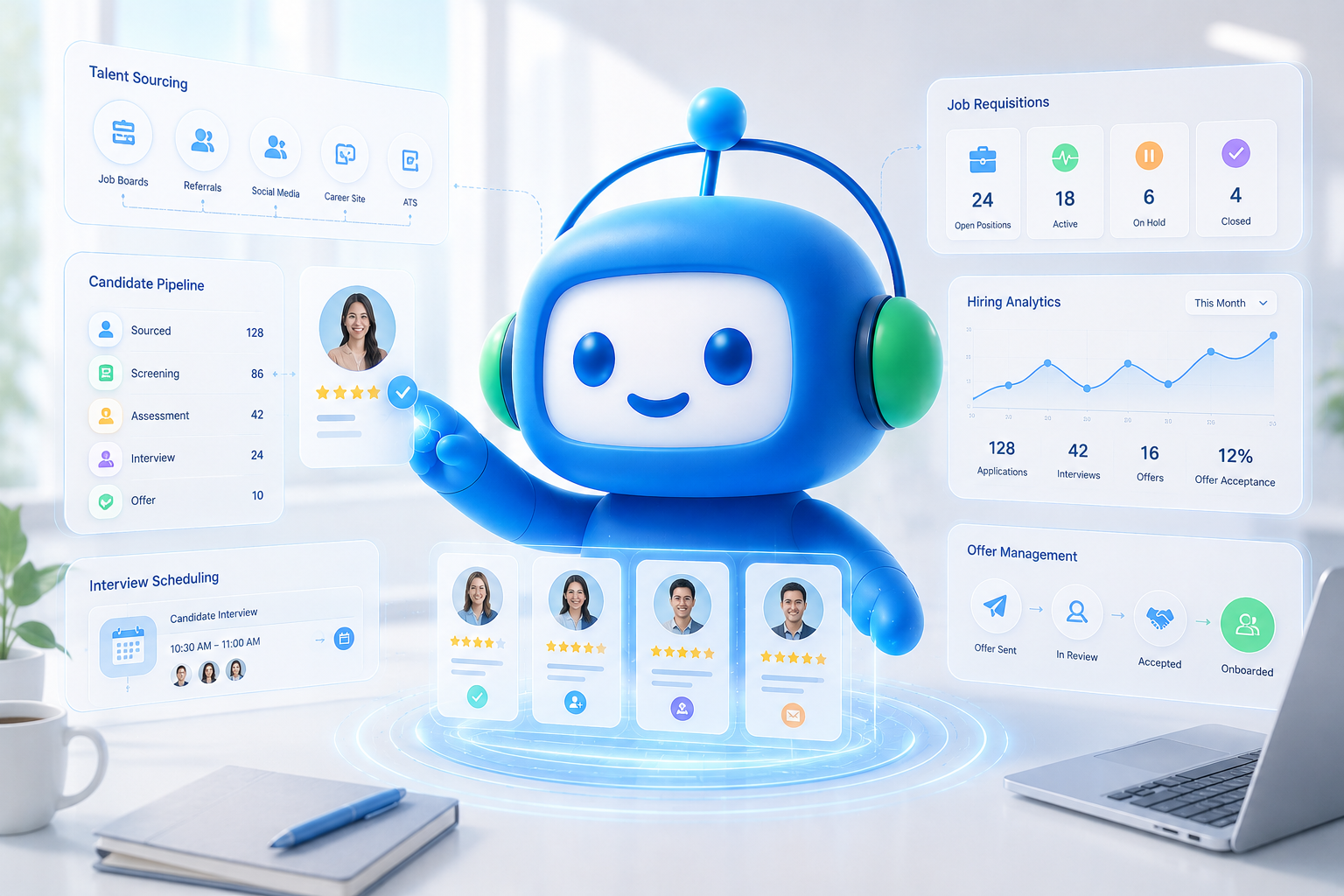
TalentRecruit’s GAIA Autopilot orchestrates sourcing, screening, engagement, interviews, offers, and onboarding autonomously. Erika, the agentic AI recruiter at the center of the platform, does not wait for a recruiter to tell it what to do next. It reads the situation, plans the next action, executes it, and moves forward, across the full hiring funnel, without per-step human prompting.
Here is what that means at each stage of the process.
Sourcing that runs continuously without recruiter input
In a recruiter-assist model, sourcing starts when a recruiter opens a search tool and types a query. In an autonomous model, sourcing starts the moment a job requisition is created and runs continuously until the role is filled. Erika’s AI sourcing agent scans internal talent pools and external sources, identifies matched candidates including passive talent not actively applying, and builds a shortlist without a recruiter initiating or managing the search.
Screening that does not require recruiter bandwidth to scale
In a recruiter-assist model, AI might rank resumes, but a recruiter still needs to review each ranking and decide what to do with it. In an autonomous model, screening runs through pre-qualification, conversational AI interviews, and assessment, producing a ranked shortlist with visible reasoning, without the recruiter being involved in each individual evaluation. The recruiter receives a shortlist that is ready for their judgment, not a list of resumes that requires their effort to process.
Engagement that does not depend on recruiter memory
In a recruiter-assist model, follow-up communications are drafted by AI when a recruiter asks for them. In an autonomous model, Erika’s candidate engagement agent maintains proactive, personalized, multi-channel communication with every candidate throughout the process, 24 hours a day, seven days a week, without a recruiter triggering each touchpoint. Candidates do not fall through the cracks because the AI does not have a bandwidth limit.
Scheduling that coordinates both sides without manual intervention
In a recruiter-assist model, scheduling tools suggest available slots and send invites when a recruiter sets them up. In an autonomous model, calendar sync, panel coordination, candidate confirmation, and rescheduling all happen automatically, without a recruiter in the middle of the coordination chain. The interview gets scheduled. The recruiter finds out when it is confirmed.
Workflow orchestration that connects every stage
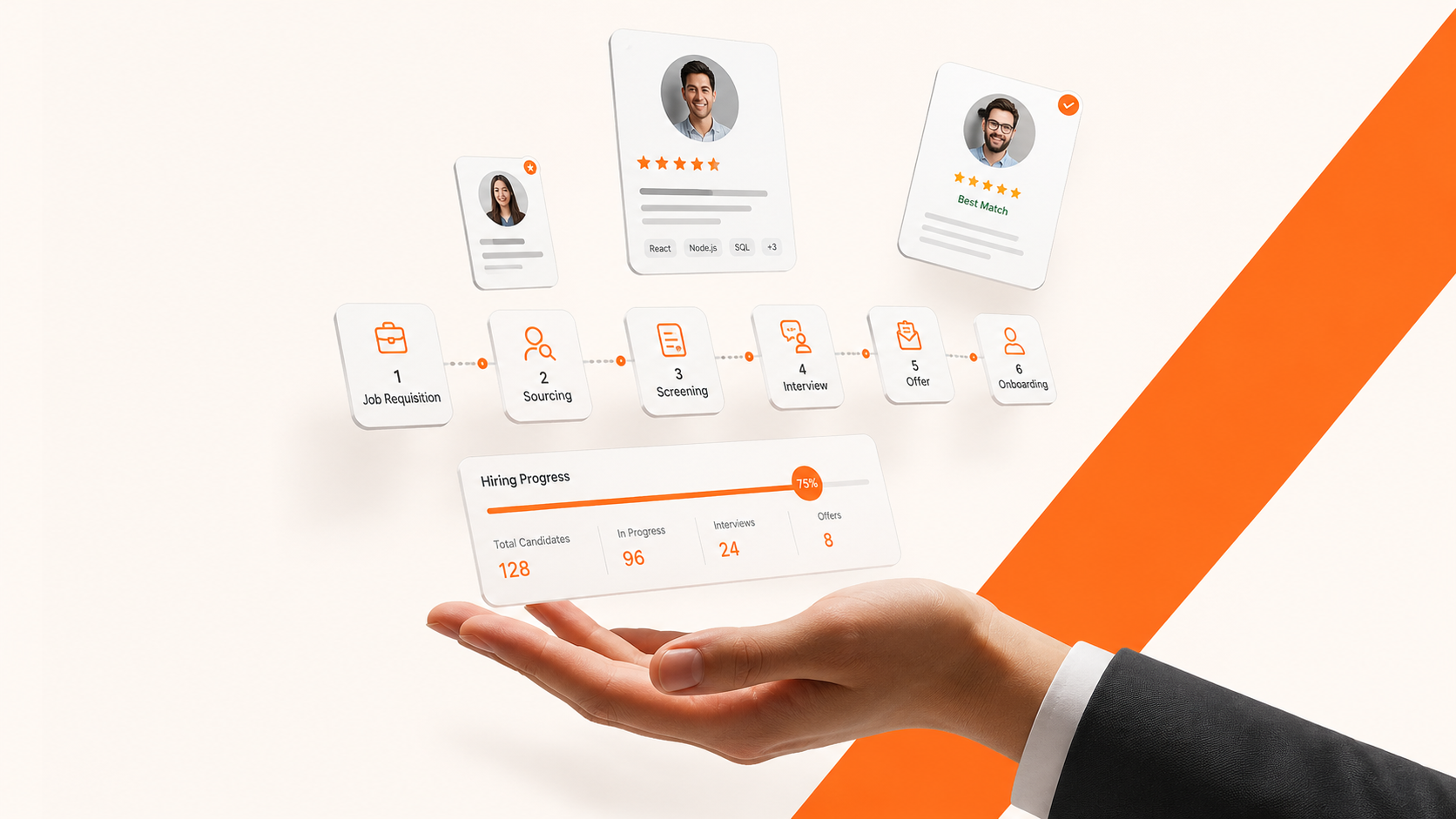
This is the capability that recruiter-assist AI fundamentally cannot replicate. In a recruiter-assist model, the recruiter connects the stages. In TalentRecruit’s autonomous model, GAIA Autopilot orchestrates the entire workflow, ensuring that the output of each stage automatically triggers the next, with the right information flowing through the system without manual intervention. There is no stage gap where candidates wait because a recruiter has not yet moved them forward.
The Recruiter’s Role in an Autonomous System
The case for autonomous hiring is sometimes misread as a case against recruiters. It is not.
What autonomous hiring changes is where recruiter judgment is applied. In a recruiter-assist model, recruiters spend the majority of their time on execution: triggering actions, managing communications, coordinating between stages, and doing the manual work that the AI helped with but did not complete. In an autonomous model, the execution is handled by the system. Recruiter judgment is concentrated on the decisions that genuinely require it: the final call on a shortlisted candidate, the conversation with a hiring manager about why the brief needs to change, the relationship with a senior candidate who needs a human to close.
This concentration of recruiter effort on high-judgment work is not a reduction in the recruiter’s value. It is a significant increase in it. The recruiter who was previously spending 60% of their time on coordination and execution and 40% on judgment can now apply 80% or 90% of their time to the work that actually moves hiring outcomes.
For enterprise TA leaders thinking about the capability of their function, this is the real argument for autonomous hiring. Not faster tasks. A fundamentally more capable team.
The Window for Making This Choice
The shift from recruiter-assist to autonomous hiring is already underway across Indian enterprise and global organizations. The teams making the shift now are building an infrastructure advantage that compounds over time: richer candidate data, warmer talent pools, faster hiring velocity, and a recruiter team that is operating at its highest value rather than its most manual.
The teams waiting for recruiter-assist AI to close the gap are going to find that it does not. The structural mismatch between the hiring challenge enterprises face in 2026 and the capability of an AI that helps rather than acts is not one that more features in the assist category will resolve.
The question for TA leaders in 2026 is not whether autonomous hiring is the direction the market is moving. The data on that is clear. The question is whether their organization makes the shift while the window for competitive advantage is still open, or after it has already closed.