



Skills-Based Hiring vs Degree-Based Hiring: What It Means for Your ATS in 2026
For decades, the degree was the filter.
A hiring manager looking at a stack of applications used educational credentials as the first pass: which university, which program, which grade. It was a proxy for capability imperfect, but consistent and easy to apply at scale. The logic was simple: if the education system had already filtered for a certain level of ability and commitment, the hiring process could start from there.
That logic is breaking down fast. And in India, it is breaking down faster than almost anywhere else.
Roughly 85% of Indian employers now say they prioritise demonstrated skills over degrees when shortlisting candidates. The shelf life of technical skills has dropped to approximately 2.5 years meaning the degree a candidate earned four years ago may already be less relevant than a certification they completed last quarter. Recruiters at GCCs, tech firms, and BFSI organisations are increasingly looking past the tier-1 college filter in favour of micro-credentials, portfolios, and verified competency signals. Verified skill badges, in many hiring contexts, now carry more weight than an MBA from a name institution.
This shift has significant implications for how hiring works in practice. But the conversation about skills-based hiring almost always focuses on the philosophy and rarely on the infrastructure question that actually determines whether the shift is possible.
Because here is the problem: most ATS platforms were built for a degree-based world. And running a skills-based hiring strategy on infrastructure that was not designed for it creates a gap that good intentions alone cannot close.
What Degree-Based Hiring Looks Like Inside an ATS
In a degree-based hiring model, the ATS is configured around credentials. Filters require a minimum qualification. Keyword searches look for university names and program types. Resume parsing flags educational background as a primary field. Candidate profiles are organized around the same data structure that a human recruiter would have used to manually sort a stack of CVs: name, institution, degree, years of experience.
This structure is not accidental. It reflects how hiring was done before the ATS existed, digitized and made searchable. The ATS made degree-based screening faster. It did not question whether degree-based screening was the right approach.
The result is a system that is structurally biased toward credentials over capability. A candidate who attended a tier-1 institution and held an impressive title at a known company surfaces easily. A candidate with equivalent or superior skill, acquired through a non-traditional path, is systematically harder to find, harder to evaluate, and harder to rank fairly against credentialled peers.
When organisations decide to shift toward skills-based hiring, they often discover that their ATS is the primary obstacle. Not because the team does not believe in the approach, but because the platform they are running it on was never designed to support it.
What Skills-Based Hiring Actually Requires From an ATS
Making the shift from degree-based to skills-based hiring is not a policy change. It is an infrastructure change. And it has specific requirements that a traditional ATS typically cannot meet.
Skill evaluation that goes beyond resume parsing
In a degree-based model, the resume is the primary evaluation document. In a skills-based model, the resume is one signal among several. An ATS built for skills-based hiring needs to evaluate candidates across multiple inputs: what they say about their skills, what assessments reveal about their actual competency level, what a conversational interview uncovers about their ability to apply knowledge in context, and what engagement signals indicate about their approach to the role.
Resume parsing captures the first of these. The other three require something a standard ATS cannot provide.
A skills framework that reflects actual role requirements
Skills-based hiring requires a clear, structured understanding of what skills a role actually needs, at what level, and in what combination. This is harder than it sounds. Job descriptions written by hiring managers typically reflect what the last person in the role did rather than what the next person needs to be able to do. Converting them into a skills framework that an ATS can evaluate candidates against requires deliberate effort and a platform capable of supporting it.
Without this framework, skills-based hiring defaults to a different kind of keyword matching: instead of searching for degree names, the system searches for skill keywords. The candidate who uses the exact terminology scores higher. The candidate with equivalent ability who describes it differently does not. The bias changes but the structural problem remains.
Consistent, bias-free evaluation at scale
One of the strongest arguments for skills-based hiring is that it can reduce the bias that credential-based filtering introduces. A degree requirement implicitly filters for candidates who had access to that degree, which correlates with socioeconomic background, geography, and opportunity rather than raw capability. Skills-based evaluation, done well, should be more meritocratic.
But this only holds if the evaluation itself is consistent. Human evaluators assessing skills in an interview bring their own biases. Manual resume review for skill signals is inconsistent at volume. The promise of skills-based hiring is only realised when the evaluation is applied consistently to every candidate, at every stage, regardless of who is reviewing them.
This is the specific gap that AI-powered evaluation closes.
How TalentRecruit’s Deep Skill Intelligence Makes Skills-Based Hiring Real
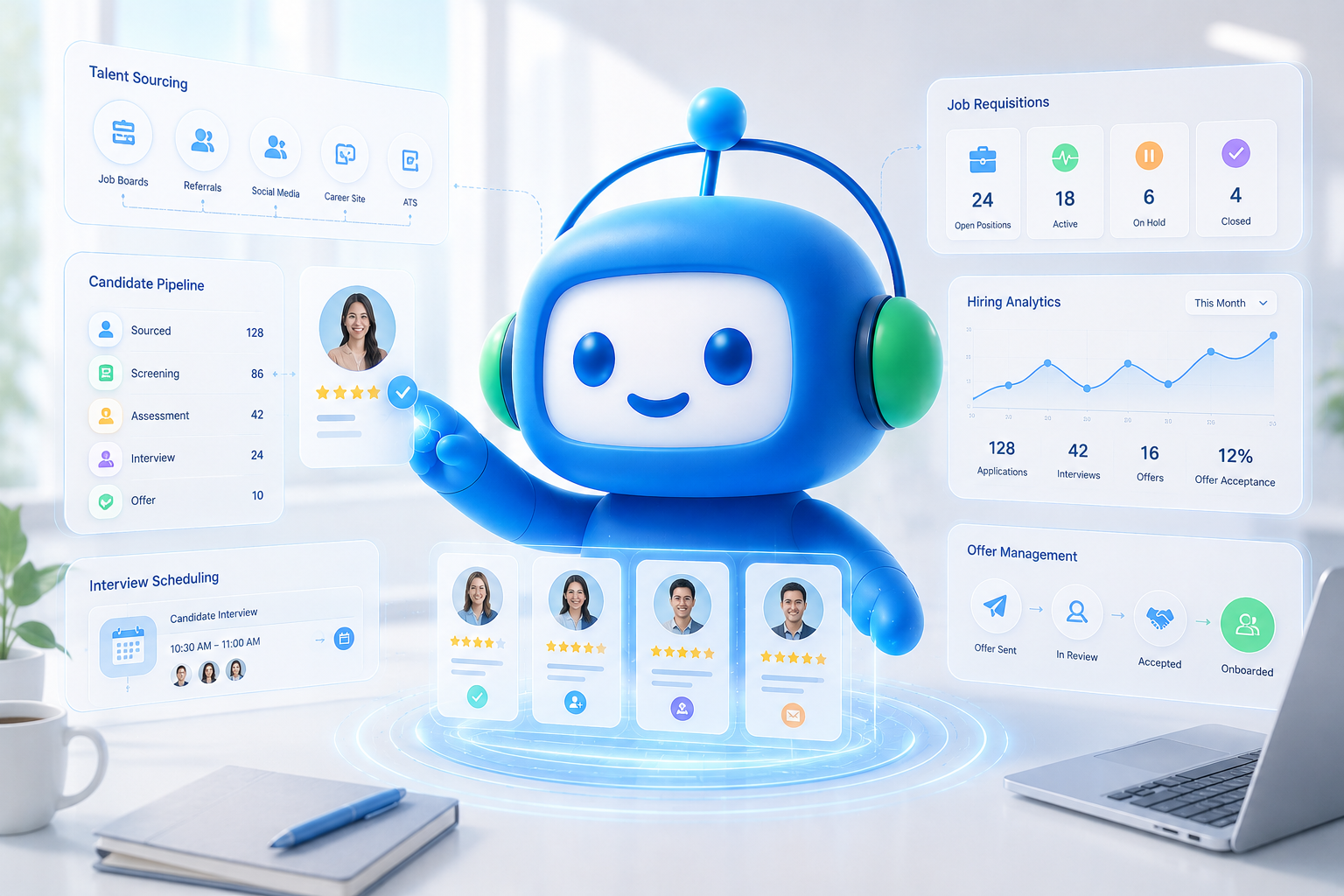
TalentRecruit’s Deep Skill Intelligence is built specifically for the evaluation challenge that skills-based hiring creates. It brings together signals from resumes, conversational AI interviews, assessments, and candidate engagement touchpoints into unified, explainable candidate insights. No single data source determines the outcome. The overall picture is built from multiple evaluation layers working together.
Here is what that means in practice for a TA team making the shift from degree-based to skills-based hiring.
Multi-signal evaluation that sees past the credential
A candidate who attended a regional college but has demonstrable skills in the areas the role requires surfaces in a Deep Skill Intelligence evaluation on the merit of those skills, not on the reputation of the institution. The evaluation is built from what the candidate can do, not where they studied or who they worked for.
A candidate with an impressive credential but weak skill signal in the areas the role requires does not rank highly purely on the basis of that credential. The multi-signal evaluation produces a more accurate picture of actual fitment than a resume alone could provide.
Conversational AI interviews that assess applied capability
Erika’s conversational AI interviews go beyond asking candidates to list their skills. They probe for applied capability: how a candidate approaches a problem, how they have used a skill in a real context, and how they respond when the question does not have an obvious answer. The output is a structured assessment of demonstrated capability rather than a self-reported skill list.
For skills-based hiring, this is the layer that most traditional ATS platforms cannot provide. The difference between a candidate who has listed a skill on their profile and a candidate who can actually apply it in context is exactly the difference that conversational AI evaluation reveals.
Stack-ranked shortlists based on skill fitment, not credential match
When the evaluation is complete, TalentRecruit produces a stack-ranked shortlist where candidates are ordered by their demonstrated fitment to the role’s skill requirements, with the reasoning behind each ranking visible. Recruiters and hiring managers can see why a candidate ranked where they did and challenge or validate the ranking with their own judgment.
This transparency is particularly important for skills-based hiring, where the shift from credential-based decisions to skills-based ones needs to be explainable to stakeholders who may not have made that shift yet. When a candidate from a non-traditional background ranks highly, the visible skill-based reasoning makes the recommendation credible rather than requiring the recruiter to argue for it on instinct alone.
Assessment integration that verifies what candidates claim
Skills-based hiring without assessment is just a different kind of self-reporting. A candidate who claims proficiency in a skill still needs to demonstrate it. TalentRecruit’s integrated assessment ecosystem connects assessment results directly into the candidate’s overall evaluation profile, so verified competency feeds into the ranking alongside resume signals and interview outputs.
The result is a hiring decision based on demonstrated, verified capability rather than claimed credentials or self-reported experience.
The India-Specific Opportunity
India’s skills-based hiring transition has a dimension that makes it particularly significant. The country has one of the largest graduate populations in the world and simultaneously one of the most significant skills gaps. A degree is common. Demonstrated, job-ready capability in the skills the market actually needs is far less so.
India’s Skill India Mission and the rapid growth of employer-recognized certifications and micro-credentials are creating a talent pool that does not fit neatly into the credential-first framework most legacy ATS platforms are configured for. Candidates with Google Career Certificates, AWS certifications, industry-specific credentials, and practical project experience are increasingly competitive for roles that traditionally required four-year degrees.
The organisations that build their hiring infrastructure to evaluate these candidates fairly and effectively are expanding their addressable talent pool significantly. The ones still running credential-based filters are competing for the same narrower pool as everyone else, in a market where that pool is increasingly insufficient for the roles that need filling.
The ATS Configuration Question Every TA Leader Should Be Asking
The shift to skills-based hiring in India is not slowing down. The evidence from enterprise employers, GCCs, and fast-scaling companies consistently points in the same direction: demonstrated capability is becoming the primary hiring criterion, and degree requirements are being deprioritized or eliminated for a growing proportion of roles.
The question this creates for TA leaders is not whether to make the shift. It is whether their current ATS can support it.
An ATS that filters by degree, ranks by keyword, and evaluates candidates from resume data alone is not a skills-based hiring platform. It is a degree-based hiring platform with a different label. The shift to skills-based hiring requires infrastructure that was actually built for it: multi-signal evaluation, conversational capability assessment, consistent bias-free ranking, and the transparency to make skills-based decisions credible to the stakeholders who need to act on them.
In 2026, the organisations that get this right are not just hiring more fairly. They are hiring better, from a broader talent pool, with more accurate predictions of who will actually succeed in the role.
That is the real return on making skills-based hiring work in practice, not just in principle.