



Why BFSI Hiring Teams Are Turning to Autonomous ATS Platforms in 2026
Hire fast. Stay compliant. Don’t compromise on quality. For most industries, you’d pick two. In BFSI, you don’t get that option.
Every role carries regulatory weight. Every hire touches compliance. A wrong placement in a banking operations team or an insurance underwriting desk isn’t just a performance problem it’s a risk exposure. And yet, the volume of hiring in this sector hasn’t slowed down. If anything, the push toward digital banking, neo-finance, and insurance-tech has made BFSI one of the most aggressively hiring industries in India right now.
The result is a tension that most BFSI talent acquisition teams live with daily: hire fast, but hire right. Move quickly, but stay compliant. Scale up, but don’t compromise on quality screening.
Traditional ATS platforms were not built for this tension. They were built to store and track, not to resolve it. That’s precisely why BFSI hiring teams in 2026 are making a different choice.
The BFSI Hiring Problem Is Not What Most People Think It Is
When people talk about challenges in BFSI recruitment, the conversation usually lands on volume or regulatory complexity. Both are real. But the deeper problem is what happens at the intersection of the two.
High-volume hiring with manual screening means shortcuts. Shortcuts in a compliance-sensitive environment mean risk. And risk in BFSI doesn’t stay contained, it compounds.
Consider what a typical BFSI TA team is managing at any given point: multiple open requisitions across functions retail banking, wealth management, claims processing, risk and compliance each with different skill requirements, different regulatory considerations, and different urgency levels. They’re screening hundreds of applicants per role, manually cross-referencing qualifications, coordinating interview panels across geographies, and trying to get offer letters out before a competitor does.
All of this, often, on an ATS that was implemented years ago and was never designed for the complexity they’re running today.
Why a Standard ATS Is No Longer Enough for BFSI
A traditional ATS does what it was designed to do: collect applications, move candidates through stages, and generate reports. For a small team hiring for a handful of roles a month, that’s functional enough.
For a BFSI organisation running high-volume hiring across multiple business units, it isn’t.
Here’s what a standard ATS typically can’t do for BFSI teams:
It can’t screen for compliance-specific qualifications automatically. It can’t flag mismatches between a candidate’s profile and a role’s regulatory requirements without manual intervention. It can’t continuously source passive candidates for niche roles like risk analysts or treasury specialists who rarely apply through job boards. It can’t produce the kind of structured audit trail that a compliance officer needs when hiring decisions are later questioned.
These aren’t edge-case requirements. For BFSI, they’re baseline expectations.
What Autonomous ATS Platforms Do Differently
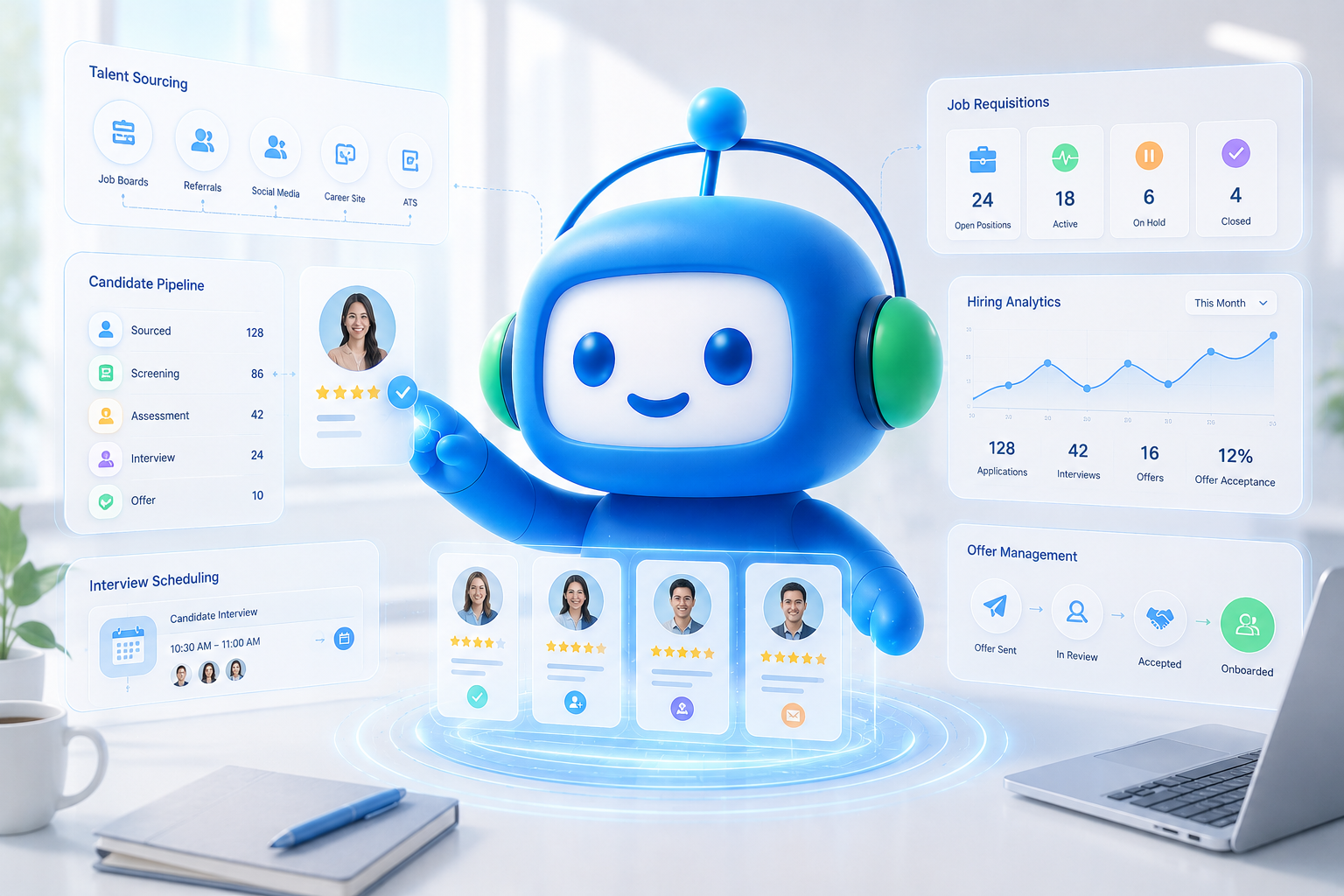
An autonomous ATS one with AI agents built into its core rather than bolted on as an afterthought approaches BFSI hiring differently from the ground up.
Intelligent sourcing that doesn’t wait for applications
The strongest candidates for specialised BFSI roles certified financial planners, risk and compliance professionals, actuaries are rarely active job seekers. An autonomous platform continuously scans talent pools and external sources, surfacing matched candidates based on role requirements rather than waiting for inbound applications that may never come.
Screening that understands context, not just keywords
AI-led pre-qualification goes beyond resume keyword matching. It evaluates candidate profiles against the structured requirements of each role including domain-specific qualifications, certifications, and experience signals that matter in regulated environments and ranks candidates accordingly. What would take a recruiter hours of manual review happens in minutes, at scale, without the inconsistency that creeps into high-volume manual screening.
Structured workflows with built-in compliance logic
Autonomous ATS platforms allow BFSI organisations to configure hiring workflows that reflect their internal compliance requirements approval chains, verification steps, mandatory documentation and enforce them automatically. Nothing moves forward without the right sign-offs in place. Every action is logged. Every decision is traceable.
Audit-ready data at every stage
When a compliance or risk audit happens and in BFSI, it will happen the hiring team needs to be able to demonstrate that their process was fair, consistent, and documented. An autonomous platform generates this trail automatically, not as an afterthought, but as a byproduct of how the hiring process was run.
Speed that doesn’t compromise quality
Perhaps the most meaningful capability for BFSI TA teams is this: autonomous platforms compress time-to-hire not by skipping steps, but by automating them. Sourcing, screening, scheduling, and offer generation all move faster not because corners were cut, but because the manual, repetitive work in each step has been eliminated.
The India Context Makes This More Urgent, Not Less
BFSI hiring in India has its own specific pressures that compound the challenge further.
The sector is expanding rapidly new-age banks, insurance aggregators, and fintech players are all scaling headcount aggressively, often in tier-2 and tier-3 cities where traditional recruitment infrastructure is weaker. At the same time, India’s regulatory environment for financial services hiring is tightening, with greater scrutiny on background verification, qualification validation, and documentation.
Add to this the DPDP Act, which places specific obligations on how candidate data is collected, stored, and processed and the compliance surface area for BFSI TA teams in India becomes genuinely complex.
Autonomous ATS platforms built for the Indian enterprise context with configurable data privacy policies, regional compliance support, and the ability to handle hiring at scale across geographies are not a luxury for BFSI teams here. They are rapidly becoming a necessity.
What BFSI Teams Are Actually Looking for in 2026
Conversations with BFSI talent acquisition leaders in 2026 reveal a consistent set of priorities:
They want a platform that can handle end-to-end hiring from requisition to onboarding without requiring five different tools to do it. They want AI that is embedded in the process, not a separate module they have to remember to use. They want compliance built into the workflow, not managed through a parallel spreadsheet. And they want data, real-time hiring analytics that tell them not just what happened, but what’s likely to happen next.
These are not futuristic requirements. They are the table stakes for enterprise BFSI recruitment in 2026.
The Shift Is Already Happening
The BFSI organisations moving to autonomous ATS platforms today are not doing it because it sounds innovative. They’re doing it because the alternative continuing to run complex, compliance-sensitive, high-volume hiring on tools that weren’t designed for it is becoming increasingly untenable.
The question for BFSI talent acquisition teams is no longer whether autonomous hiring platforms are relevant to their sector. It’s whether they want to make the shift now, on their own terms, or later, when the gap between their process and their competitors’ has already widened.
The teams that move first don’t just hire faster. They build a hiring infrastructure that compounds better data, better candidate experience, better institutional knowledge of what good hiring looks like in their organisation.
That’s the real advantage of making the shift in 2026, while the window is still open.