



FMCG Hiring at Scale: The Hidden Complexity Nobody Talks About
Pick up any consumer product in India and trace it back to how it was made, packaged, distributed, and placed on the shelf in front of you. At every point in that chain, there are people specialized, trained, and in many cases very difficult to replace quickly.
This is the hiring reality that FMCG companies in India live with daily. And it is considerably more complex than the industry’s surface-level reputation for high-volume, straightforward recruitment suggests.
FMCG hiring in India is not one problem. It is four or five simultaneous problems happening in the same organization, often managed by the same TA team, with the same tools and the same headcount. Understanding what those problems actually are is the first step toward understanding why so many FMCG hiring functions feel permanently behind and what it takes to build a recruitment infrastructure that actually keeps pace.
The Complexity Nobody Talks About
The conversation about FMCG hiring usually starts and ends with volume. Large organizations, many open roles, continuous attrition in field and operations functions. All of that is true. But volume is the visible surface of a much deeper complexity.
The role spectrum is wider than almost any other industry.
An FMCG organization is simultaneously hiring for manufacturing floor roles, supply chain and logistics specialists, food scientists and quality assurance professionals, sales and trade marketing teams, distribution and route-to-market staff, category managers, digital marketing specialists, and senior leadership across all of these functions.
Each of these role families has a completely different candidate profile, a different sourcing channel, a different evaluation framework, and a different urgency level. A manufacturing line supervisor and a food scientist cannot be found, screened, or assessed the same way. A sales executive hire in a tier-2 city and a supply chain head hire in a metro require entirely different approaches.
Managing this breadth of role complexity under one TA function, with shared infrastructure, is where most FMCG recruitment teams start to fracture. The tools that work for high-volume field sales hiring do not work for niche technical hiring. And the tools built for niche technical hiring cannot handle the volume that field operations demand.
The specialized talent is genuinely hard to find.
Supply chain experts with FMCG-specific experience. Food scientists with category-relevant research backgrounds. Quality assurance professionals who understand both regulatory requirements and production realities. These are not candidates who appear in large numbers on standard job portals. They are typically employed, often passive, and rarely apply speculatively.
Leading FMCG organizations in India face exactly this challenge. Their talent acquisition teams need to source highly specialized talent while simultaneously maintaining the high quality standards their brand depends on. Standard sourcing approaches are not reaching these candidates at the quality or pace required.
TalentRecruit’s AI-powered search and screening processes enable FMCG teams to tap into a pool of specialized talent that traditional sourcing methods cannot access, building robust teams while maintaining the operational quality their business demands.
Seasonal and promotional demand is unpredictable but unforgiving.
FMCG hiring does not arrive at a steady pace. Festival seasons, new product launches, distribution network expansions, and promotional campaigns all trigger sudden spikes in headcount requirements. A TA team managing a steady flow of fifty open roles in August might find itself managing two hundred by October, with a business that expects the same quality of hire in half the time.
Manual hiring processes that barely keep pace with steady-state demand completely break down during surge periods. The organizations that consistently execute peak season hiring without compromising on quality are the ones whose recruitment infrastructure was built to absorb volume spikes rather than requiring additional manual effort to manage them.
Onboarding speed directly impacts operational output.
In FMCG, a new hire’s time-to-productivity matters in a very direct way. A quality assurance professional who takes six weeks to be fully operational is six weeks of reduced quality oversight on a production line. A distribution sales executive who spends two weeks on paperwork before their first customer visit is two weeks of uncovered territory.
Onboarding in FMCG is not an HR formality. It is an operational milestone. And in a fast-moving consumer business with multiple product lines and a production environment that does not pause for administrative processes, the speed and quality of onboarding directly determines how quickly the investment in a hire starts returning value.
FMCG organizations with multiple product lines and operational demands that cannot wait for slow administrative processes need onboarding automation that moves new hires through documentation, pre-boarding engagement, and onboarding workflows without manual coordination bottlenecks. The result is a faster path from accepted offer to operational contribution.
Diversity and financial governance are non-negotiable at scale.
Large FMCG organizations in India operate under increasing scrutiny on diversity hiring commitments and governance requirements. Ensuring that diversity considerations are embedded in the hiring process, not managed as an afterthought through manual review, requires platform-level support, not recruiter-level effort.
Similarly, FMCG organizations hiring across multiple geographies, business units, and product verticals need the ability to track hiring costs, manage budgets by division, and demonstrate financial accountability for recruitment spend. When this is managed manually, the numbers are always slightly out of date and slightly inconsistent.
What Autonomous Hiring Does Differently for FMCG
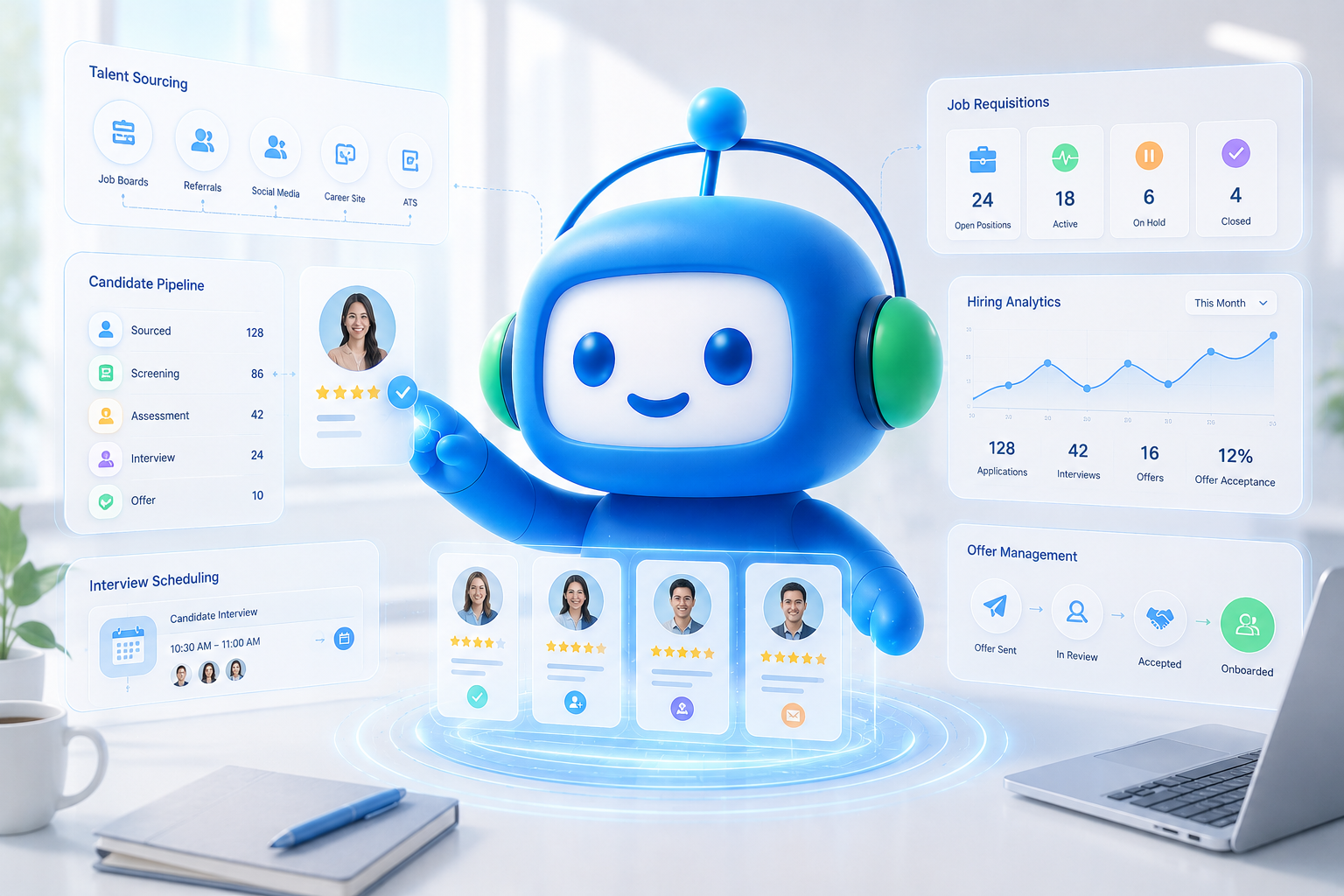
TalentRecruit’s platform addresses the specific complexity of FMCG hiring directly, not through a one-size-fits-all approach but through configurable capabilities that flex to the different needs of different role families within the same organization.
AI sourcing that reaches passive specialized talent
For the supply chain specialists, food scientists, and quality assurance professionals that FMCG organizations need but rarely find through inbound applications, Erika’s AI sourcing agent continuously identifies matched candidates across internal talent pools and external sources. The search runs against the specific requirements of each role, not generic keyword matching but structured evaluation of domain-specific skills and experience signals that standard sourcing tools miss.
Conversational AI screening that scales for field roles
For high-volume field sales, distribution, and operations roles where recruiter-led screening calls are not feasible at scale, Erika’s conversational AI interviews conduct intelligent, real-time candidate interactions that generate structured assessment data. Every candidate receives a genuine engagement experience. Every interaction produces usable evaluation signal. The recruiter receives a ranked shortlist rather than a pile of unscreened applications.
Configurable workflows for a complex role spectrum
Different role families in an FMCG organization require different hiring workflows. A manufacturing hire might require specific safety certification checks. A food science hire might require technical assessment integration. A senior leadership hire might require multi-stage panel interviews with different approval chains. TalentRecruit’s highly configurable workflow engine allows each role type to follow the process it actually requires, without forcing every hire through the same generic stages.
Fast automated onboarding that reduces time-to-productivity
TalentRecruit’s onboarding automation gives FMCG organizations the ability to move new hires through documentation, pre-boarding engagement, and onboarding workflows without manual coordination bottlenecks. The result is a faster path from accepted offer to operational contribution which in a production and distribution environment means a faster path to the business impact the hire was made to deliver.
Diversity and financial governance built into the workflow
TalentRecruit’s platform embeds diversity and financial governance directly into the hiring process. AI-driven screening that minimizes bias at scale supports diversity hiring commitments without requiring manual review of every shortlist for representation. Manpower budgeting and real-time financial tracking give FMCG TA leaders visibility into hiring spend by geography, business unit, and role type, with budget versus actual reporting available in real time rather than at the end of a reporting cycle.
The Real Cost of Getting FMCG Hiring Wrong
FMCG is an industry where the connection between workforce quality and business performance is direct and visible.
A production line short-staffed during a peak demand period produces less. A distribution network with unfilled sales territory roles covers less ground. A quality assurance team running under capacity creates risk that eventually shows up in product quality or regulatory compliance.
The cost of a slow hire in FMCG is not just a time-to-hire metric. It is a production output metric, a sales coverage metric, and sometimes a quality and compliance metric. These are costs that the business feels and that leadership notices, which is exactly why FMCG TA teams are under consistent pressure to fill roles faster without compromising on the standards that consumer-facing businesses cannot afford to compromise.
The organizations that resolve this tension are not the ones that add more recruiters to run the same manual process faster. They are the ones that build hiring infrastructure that was designed for the specific complexity of FMCG: wide role spectrum, specialized passive talent, seasonal surge capacity, fast onboarding, and governance at scale.
Streamlining Talent for Freshness and Speed
The FMCG sector’s own language captures the hiring imperative well. Freshness and speed are the operational values that define the industry. Products that reach consumers fresh, delivered fast, at consistent quality. The workforce that makes this possible needs to be hired with the same principles: the right people, sourced quickly, onboarded fast, performing at standard from the earliest possible moment.
That does not happen by accident. It happens when the recruitment infrastructure is built for it.