


What Is a Recruitment Platform and Why Does It Matter More Than Individual Tools?
Walk into almost any enterprise HR function and you will find the same thing.
A sourcing tool. A video interviewing solution. An assessment platform. A scheduling tool. An ATS to track candidates. A background verification vendor portal. An offer letter system. An onboarding solution. And a shared drive somewhere with the templates that do not fit neatly into any of the above.
Each of these tools was added for a good reason. Each one solved a specific problem at a specific moment. And together, they created a fragmented, manually coordinated recruitment infrastructure that costs more to run than it should, produces less consistent results than it could, and requires the recruiting team to spend a disproportionate amount of their time managing tools rather than hiring people.
This is the problem a recruitment platform solves. Not a better individual tool, but a fundamentally different approach to how the hiring technology stack is structured.
What a Recruitment Platform Actually Is
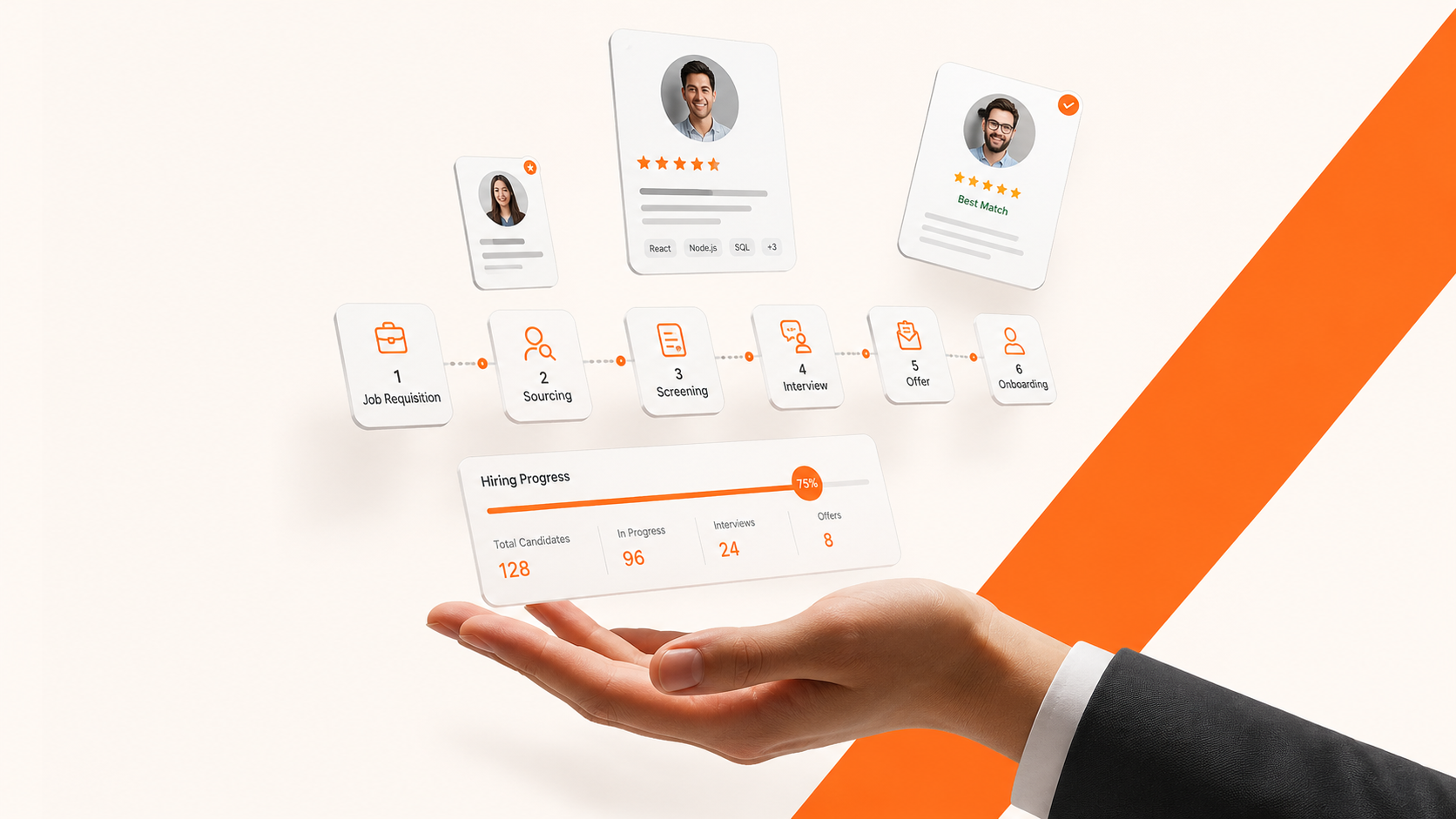
A recruitment platform is a unified system that manages the entire hiring lifecycle in one connected environment from workforce planning and job creation through sourcing, candidate engagement, screening, interviews, background verification, offer management, and onboarding.
The word that matters most in that definition is unified. Not integrated in the sense of having APIs that allow separate tools to share data with occasional errors and manual reconciliation. Unified in the sense that every stage of the hiring process exists within the same system, data flows continuously between stages without manual intervention, and the recruiter has a single view of every candidate across every stage without switching between platforms.
This is meaningfully different from what most organizations currently run, which is a collection of individual tools that are loosely connected at best and entirely separate at worst, with a recruiter acting as the manual integration layer between them.
The Hidden Cost of Individual Tools
The case for individual best-of-breed tools has always been that each one is optimized for its specific function. The sourcing tool sources better than a general platform. The assessment solution assesses more thoroughly. The video interviewing tool has better candidate experience features.
This argument has merit at the individual tool level. It does not account for what happens at the system level.
Every tool boundary creates a manual handoff.
When a candidate moves from the sourcing tool to the ATS, someone moves them. When interview feedback from the video platform needs to appear in the candidate record, someone copies it. When an offer is generated from a separate offer management system, someone ensures the details match what is in the ATS. Each of these handoffs is a manual task, a potential error point, and a source of delay.
In a hiring process with eight stages and five separate tools, there are potentially dozens of manual handoffs per candidate. Multiply that across fifty open roles and hundreds of active candidates and the recruiter’s day is largely consumed by tool management rather than hiring.
Data lives in silos, so reporting requires manual reconciliation.
When candidate data is distributed across multiple tools, generating a single coherent view of hiring performance requires someone to extract data from each system, reconcile it, and produce a report manually. By the time the report is ready, the data it contains is already out of date.
For TA leaders who need to make decisions about resource allocation, process adjustments, and hiring prioritization based on what is happening in the pipeline right now, this reporting lag is a genuine operational handicap.
Candidate experience suffers at every tool boundary.
From a candidate’s perspective, each tool boundary is often a friction point. A different login. A different interface. A link that does not work on mobile. A scheduling tool that requires them to create an account before they can confirm an interview slot. Each of these moments introduces dropout risk at a stage where the candidate’s interest and patience are already being tested.
The organizations that deliver the best candidate experience are not necessarily the ones with the best individual tools. They are the ones with the most seamless end-to-end process, because seamlessness is what the candidate actually experiences.
Security and compliance gaps widen with every additional tool.
Every additional tool in the recruitment stack is an additional surface area for data security risk and compliance complexity. Candidate personal data names, contact details, CVs, assessment results, interview recordings is distributed across multiple vendor environments, each with its own security posture and data handling practices.
Under India’s DPDP Act and GDPR for global enterprises, maintaining visibility and control over candidate data across a fragmented tool landscape is genuinely difficult. Compliance requires knowing exactly what data you hold, where it is, how it is being processed, and how long it will be retained questions that are much harder to answer when the answer spans five or six different vendor systems.
What a Unified Recruitment Platform Changes
TalentRecruit’s end-to-end hiring suite is built as a unified platform rather than a collection of connected tools. Here is what that means in practice across the hiring lifecycle.
One system from manpower planning to onboarding
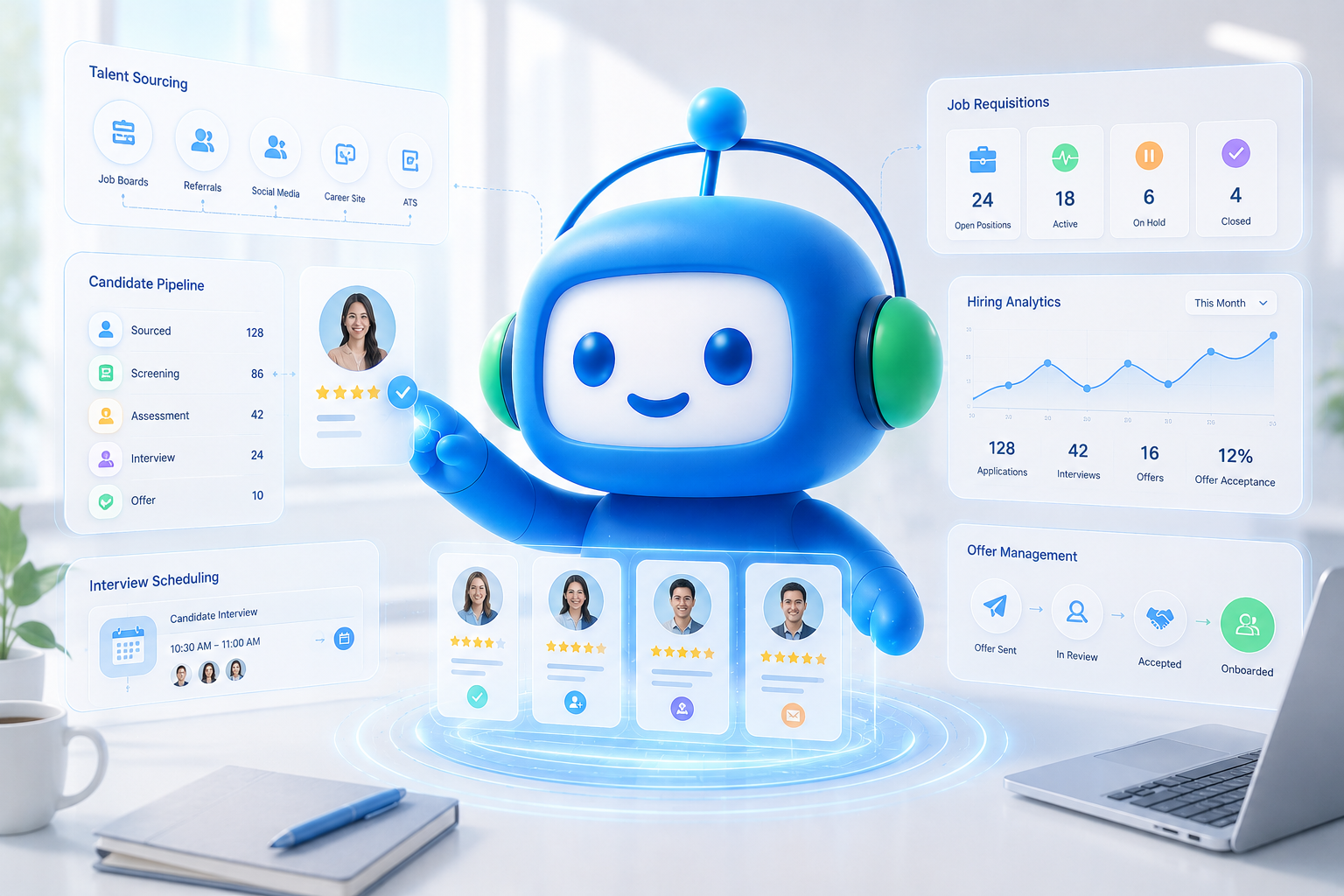
The hiring process in TalentRecruit begins before a role opens. Manpower budgeting and headcount planning connect directly to job requisition management, so TA teams have advance visibility into where demand is heading before requisitions are formally raised. From there, the same platform manages job creation and posting, candidate sourcing and referrals, engagement, assessments and screening, background verification, offer management, and onboarding, without the candidate or their data leaving the platform at any stage.
Data flows without manual intervention
Because every stage exists within the same system, candidate data flows automatically between stages based on defined workflow triggers. A candidate who clears the AI pre-qualification stage moves automatically to the interview scheduling stage. Interview feedback flows directly into the candidate record. BGV results appear in the offer management workflow without anyone manually moving them. The recruiter manages the process rather than managing the data movement between tools.
Real-time visibility across the entire pipeline
With all hiring data in one system, analytics and reporting are real-time rather than manually compiled. TA leaders can see hiring velocity, stage conversion rates, source effectiveness, and pipeline health across every role, department, and geography in the same view, at the same time, without waiting for someone to run a report from multiple systems.
A single candidate experience from application to onboarding
From a candidate’s perspective, TalentRecruit delivers a seamless experience across every stage: a branded career site, a smooth application process, AI-led engagement and communication, conversational AI interviews, scheduling confirmation, and a structured onboarding journey all within the same platform, accessible on mobile, without multiple logins or interface changes.
Compliance built into the workflow, not managed alongside it
Because all candidate data lives in one system, DPDP and GDPR compliance is managed at the platform level rather than across multiple vendor relationships. Consent is captured at the point of application. Retention policies are enforced automatically. Audit trails are generated across every hiring action. Country-specific data privacy configurations can be applied within the same platform for organizations hiring across multiple geographies.
50 plus integrations for tools that need to connect
A unified platform does not mean a closed one. TalentRecruit integrates with 50 plus platforms HRMS, ERP, SAP, background verification providers, assessment tools, calendar systems, and job boards creating a connected hiring infrastructure where external tools slot into the platform rather than sitting alongside it as separate systems.
Platform vs Tools: The Decision That Shapes Everything Else
The choice between individual tools and a unified recruitment platform is not a features decision. It is an architecture decision that shapes every aspect of how the hiring function operates.
Individual tools optimized for specific functions can deliver excellent results at each stage in isolation. The cost is the coordination overhead between stages, the data fragmentation across systems, the manual effort required to maintain consistency, and the compliance complexity of managing candidate data across multiple vendor environments.
A unified platform may not win every individual feature comparison with the best-of-breed tool in each category. The benefit is that it eliminates the coordination cost, the data fragmentation, the manual handoffs, and the compliance gaps that come with a multi-tool stack. For enterprise organizations managing hiring at scale, the system-level benefit outweighs the feature-level trade-off.
TalentRecruit is built on this premise. One platform managing the complete recruitment lifecycle, powered by Erika’s agentic AI, with 50 plus integrations creating a connected hiring infrastructure rather than a fragmented one.
The result is not just a more efficient hiring process. It is a hiring function that can scale with the business, deliver consistent quality across volume, and give every stakeholder recruiter, hiring manager, TA leader, and candidate the experience the process is supposed to deliver.