


AI Recruiting Assistant vs AI Recruiting Agent: What Is the Difference?
The terminology around AI in recruitment is moving faster than most hiring teams can track.
Two years ago, the dominant conversation was about AI recruiting assistants, tools that helped recruiters work faster, responded to candidate queries automatically, and handled routine communication without requiring a human to draft every message. That felt like a significant step forward at the time, and it was.
In 2026, the conversation has moved. The term appearing more frequently is AI recruiting agent and while it sounds like a subtle rebrand of the same technology, the operational difference between the two is anything but subtle.
Understanding that difference is not an academic exercise. It has direct implications for what your hiring team can accomplish, how much manual effort your process still requires, and whether the AI investment you are making is changing the capacity of your function or just the speed of individual tasks.
What an AI Recruiting Assistant Actually Does
An AI recruiting assistant is a tool that helps a recruiter do their job more efficiently. The key word is helps.
It responds to candidate queries when a recruiter is not available. It drafts emails when a recruiter asks it to. It suggests interview questions when a hiring manager needs a starting point. It summarizes a resume when a recruiter clicks a button. It ranks candidates after a recruiter has already collected a pool of applications.
In each of these cases, the recruiter initiates the action and the AI executes it. The AI is responsive. It performs tasks when prompted. It reduces the time individual actions take without changing the fundamental structure of who is managing the workflow.
This is genuinely useful. A recruiting assistant that responds to candidate queries around the clock, drafts personalized outreach at scale, and helps generate job descriptions faster saves meaningful recruiter time. For teams that were doing all of these things manually, an AI assistant is a real improvement.
But it is an improvement in efficiency, not in capability. The recruiter is still the engine of the process. The AI is a faster set of tools.
What an AI Recruiting Agent Actually Does
An AI recruiting agent operates from a different premise entirely.
Rather than waiting for a recruiter to initiate an action and then executing it, an AI recruiting agent autonomously orchestrates multi-step workflows toward a defined goal. It does not need to be prompted for each task. It reads the situation, plans the next action, executes it, and moves forward across the full hiring workflow without per-step human direction.
The distinction between responsive and autonomous is the core of the difference.
An AI assistant responds to “draft an outreach email for this candidate.” An AI agent identifies the candidate, decides outreach is needed, drafts the message, sends it at the optimal time, tracks the response, and moves the candidate to the next stage based on the outcome without a recruiter being involved in any individual step of that sequence.
An AI assistant responds to “schedule an interview for this candidate.” An AI agent identifies that a candidate is ready for an interview, checks panel availability, shares slots with the candidate, confirms the booking, generates the meeting link, sends reminders, and logs the outcome back into the hiring workflow autonomously, from start to finish.
The recruiter does not disappear from this picture. They move to a different position in it: reviewing what the agent has done, making judgment calls on candidates that warrant closer consideration, and managing the relationships and conversations that require human engagement. The agent handles the execution. The recruiter handles the decisions.
How Erika Embodies This Distinction
Erika, TalentRecruit’s AI recruiter, started as a virtual recruitment assistant a 24×7 AI that responded to candidate queries, sent personalized outreach, and kept talent pipelines warm when recruiters were not available. That assistant capability remains part of what Erika does. But Erika has evolved significantly beyond it.
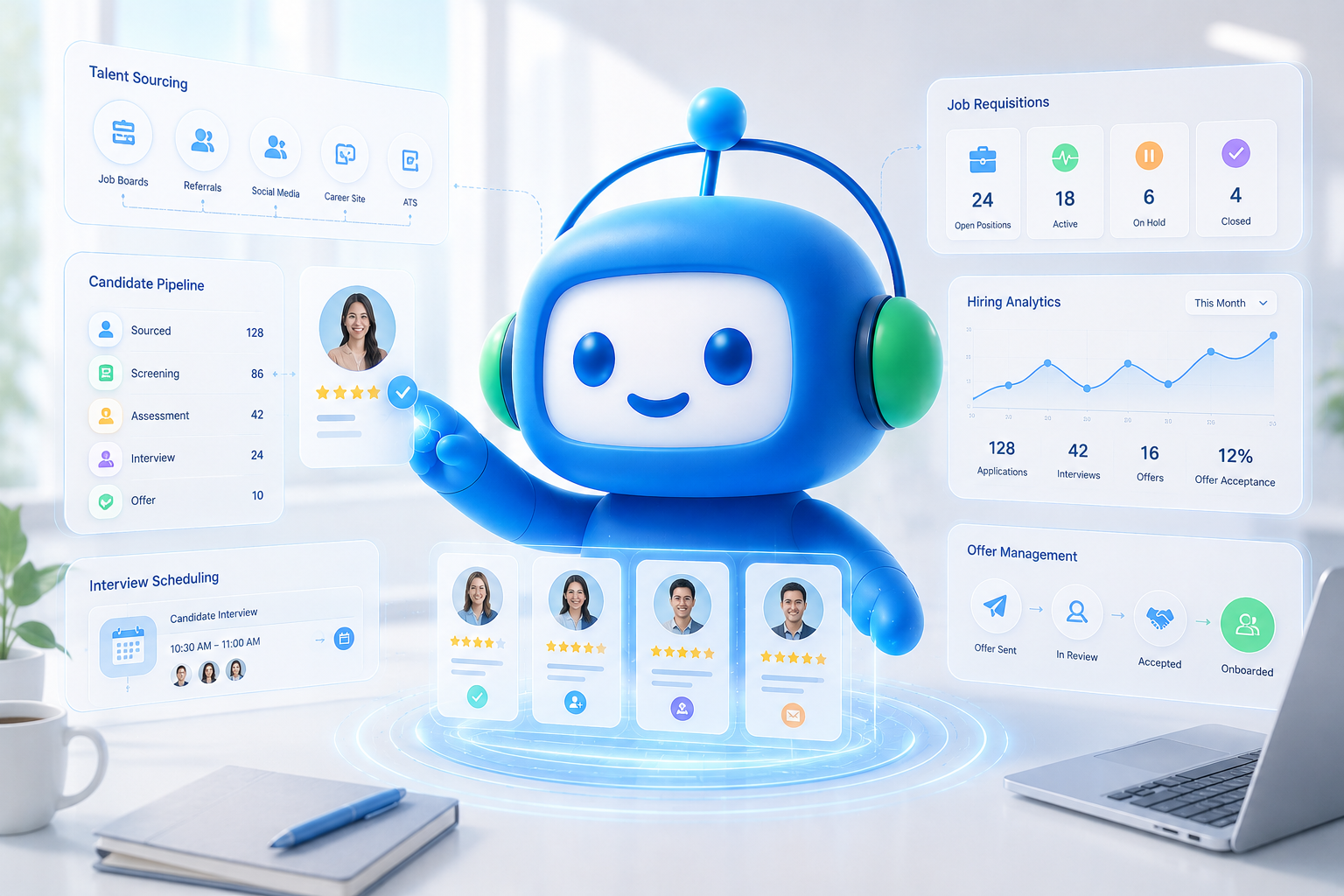
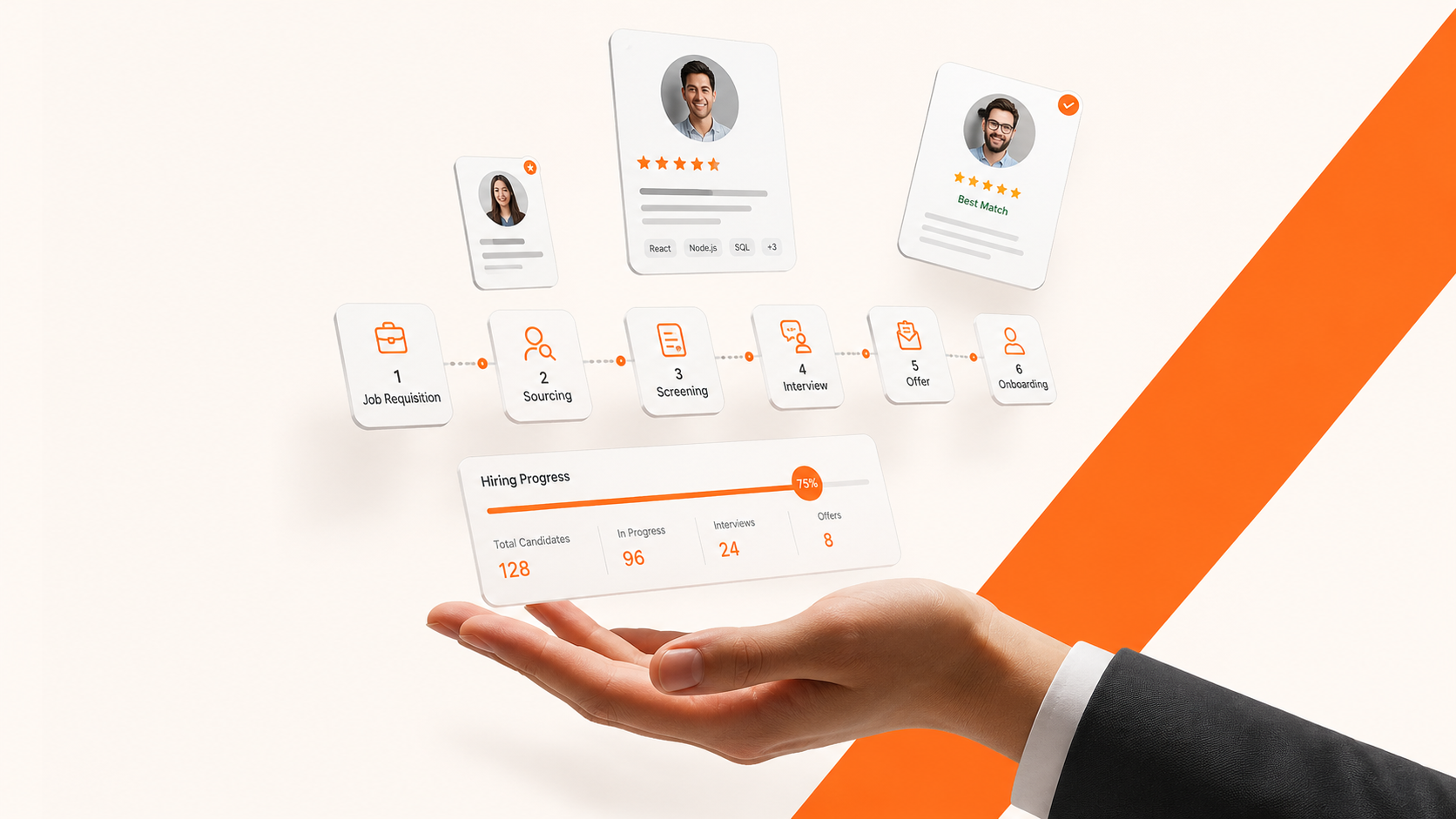
In its current form, Erika is an agentic AI recruiter. It autonomously orchestrates sourcing, screening, engagement, and hiring workflows not as separate features that a recruiter activates one at a time, but as a connected, continuously running process that executes across the full recruitment lifecycle.
Here is what that looks like across each stage of hiring.
Sourcing: Erika’s AI sourcing agent does not wait for a recruiter to open a search tool and type a query. It continuously identifies matched candidates across internal talent pools and external sources from the moment a job requisition is created, building a pipeline without recruiter initiation.
Candidate engagement: Erika proactively reaches out to candidates, recommends relevant opportunities, responds to queries in real time, and maintains personalized multi-channel communication throughout the hiring journey around the clock, without recruiter bandwidth being the constraint.
Pre-qualification and screening: Erika’s AI pre-qualification agent evaluates every application against the role’s structured requirements, producing a ranked shortlist with visible reasoning. The recruiter receives the shortlist rather than having to manually process every application to produce it.
Conversational AI interviews: Erika conducts real-time intelligent candidate interactions through AI bot interviews, generating structured assessment data from every candidate at scale. The output feeds directly into candidate evaluation without a recruiter needing to run individual screening calls.
Interview scheduling: Erika syncs calendars, coordinates panel availability, shares slots with candidates, and confirms interviews without manual recruiter coordination on either side.
Interview insights: After each interview, Erika generates AI-powered summaries, transcripts, and skill-level evaluations so the recruiter has structured assessment data to work from rather than relying on panel feedback submitted days later.
Each of these capabilities can operate as a standalone feature. Together, orchestrated by Erika as an agentic AI recruiter, they form a continuous, autonomous hiring workflow that executes from job creation to hire without requiring a recruiter to manually connect every stage.
Why the Difference Matters for Your Hiring Team
The practical implications of this distinction show up in three areas that matter directly to enterprise TA teams.
Capacity, not just speed
An AI assistant makes your current process faster. An AI agent changes what your team can process.
A recruiter using an AI assistant still manages every role manually they just do each individual task in less time. A recruiter working alongside an AI agent can manage a significantly higher volume of roles because the agent is handling the execution layer of most of them simultaneously.
For enterprise TA teams managing high-volume hiring across multiple functions and geographies, this capacity difference is not incremental. It is the difference between a team that keeps pace with business hiring demand and one that is permanently behind it.
Quality through consistency
An AI assistant improves the quality of individual tasks when a recruiter uses it. An AI agent applies consistent quality to every candidate, every time, regardless of recruiter bandwidth, time of day, or how many other roles are being managed simultaneously.
The two hundredth application reviewed by an AI agent receives the same quality of evaluation as the second. The candidate who applies on a Friday evening receives the same speed of response as the one who applies on a Monday morning. This consistency is structurally built into how an agent operates it does not vary with human factors.
Strategic reallocation of recruiter time
When an AI agent handles the execution layer of hiring, recruiter time is freed for the work that actually requires human judgment: the final call on a shortlisted candidate, the conversation with a hiring manager about why the brief needs adjustment, the relationship with a senior candidate who needs a human engagement to close.
This is not a reduction in the recruiter’s role. It is a concentration of their role on the work where their judgment genuinely changes outcomes. The recruiter who was spending 60% of their time on coordination and execution can now spend 80% or more on the decisions that actually determine whether hiring delivers what the business needs.
Which One Does Your Team Actually Have?
The easiest way to identify whether you are working with an AI assistant or an AI agent is to ask a single question: what does the AI do when nobody tells it to do anything?
An AI assistant does nothing. It waits for a prompt. It is reactive by design.
An AI agent continues working. It monitors the pipeline, identifies the next action needed, executes it, and moves forward. It is proactive by design.
If your AI recruitment tool requires a recruiter to initiate every meaningful action, it is an assistant. If it continues running the hiring workflow autonomously while your team is focused on other things, it is an agent.
For hiring teams evaluating AI recruitment tools in 2026, this single question is one of the most useful filters available. The answer tells you more about what a tool will actually change for your function than any feature list or demo walkthrough will.
The Direction the Market Is Moving
The shift from AI recruiting assistants to AI recruiting agents is already underway in enterprise hiring. Enterprise deployment of autonomous AI agents jumped from 11% to 42% in just six months according to research from 2026, and the primary driver is exactly the distinction described here: organisations are discovering that AI that helps is useful, but AI that acts is transformative.
The teams building their hiring infrastructure around AI agents rather than AI assistants are not just hiring faster. They are building a fundamentally different kind of TA function one where the operational layer of hiring runs autonomously and recruiter judgment is concentrated on the decisions that actually require it.
That is the future of AI in recruitment. And in 2026, for the enterprises moving in that direction, it is already the present.