



Why GCC Hiring in India Is a Different Problem, And How AI Solves It
India crossed a significant threshold in 2026.
With over 1,600 Global Capability Centers now operating across the country and employing more than 1.6 million professionals a number growing at roughly 15% annually, India is no longer just the world’s back office. GCCs have evolved from cost arbitrage units into strategic innovation hubs. Global P&L roles, product leadership, engineering VPs, and AI research functions now sit in India. The nature of the work has changed. The talent it requires has changed with it.
And the hiring challenge that comes with building and scaling a GCC in India is unlike anything a standard enterprise ATS was designed to handle.
Why GCC Hiring Is a Category of Its Own
When a multinational sets up or expands a GCC in India, they’re not simply opening an office. They’re building a capability one that’s expected to deliver to global standards, operate within India’s talent market dynamics, comply with both the parent company’s policies and India’s regulatory requirements, and do all of this faster than the business plan anticipated.
The hiring problem that surfaces in this context has layers that don’t exist in domestic enterprise recruitment.
The talent profile is specialized and contested. GCCs in 2026 are hiring for roles that sit at the intersection of domain expertise and advanced technology AI engineers, MLOps specialists, product leaders with global accountability, cloud architects, data scientists, and senior leadership capable of managing globally distributed teams. These are not roles that can be filled through a standard job posting and a two-week screening process. The candidates are rare, are already employed, and are being approached by multiple GCCs simultaneously.
The hiring brief changes as the GCC evolves. A GCC in its first year needs a different kind of talent than one in its fifth. Early hires are often generalists who can build from scratch. As the center matures, the need shifts toward deep specialists and leaders who can scale functions globally. The recruitment infrastructure needs to flex with the organization’s stage not stay locked in the setup it had at launch.
The parent company has its own processes, and India has its own realities. GCC TA teams often sit at the intersection of the parent organization’s global hiring policies structured interview frameworks, standardized assessment criteria, global HRIS systems and India’s local talent market, where candidate behavior, notice periods, compensation expectations, and sourcing channels all operate differently. Managing this tension manually, across two or three geographies, with recruiter teams on both ends, is where most GCC hiring operations start to fracture.
Multi-geography compliance is not a checkbox it’s a continuous obligation. A GCC operating across Bengaluru, Hyderabad, Pune, and Mumbai while also coordinating with parent company stakeholders in the US, Europe, or Southeast Asia is managing candidate data across multiple regulatory environments simultaneously. GDPR for European stakeholders involved in the hiring process. India’s DPDP Act for candidate data collected locally. The parent company’s internal data governance policies layered on top of both.
Managing this without a platform specifically built for configurable, country-level data privacy compliance is not just operationally difficult. It’s a liability.
Where Standard ATS Platforms Break Down for GCCs
Most ATS platforms were built for one geography, one hiring team, and one compliance framework. GCC hiring is structurally none of these things.
A standard ATS doesn’t know the difference between a candidate consented under GDPR and one consented under India’s DPDP Act. It doesn’t automatically apply the right retention policy based on where the candidate is located. It doesn’t give a global CHRO visibility into hiring velocity across six Indian cities while simultaneously giving a Bengaluru-based TA lead a view of just their pipeline.
A standard ATS also doesn’t handle the sourcing complexity that GCC hiring demands. When the best candidates for a GCC’s senior engineering roles are not actively applying because they’re already employed, well-compensated, and being courted by five other GCCs a system that waits for applications is structurally inadequate.
And when the GCC needs to hire 200 people in six months to meet an expansion milestone, while simultaneously maintaining the structured interview process the parent company requires for quality assurance, a standard ATS becomes the bottleneck that the business is planning around rather than the infrastructure enabling it.
What AI-Powered Autonomous Hiring Changes for GCCs
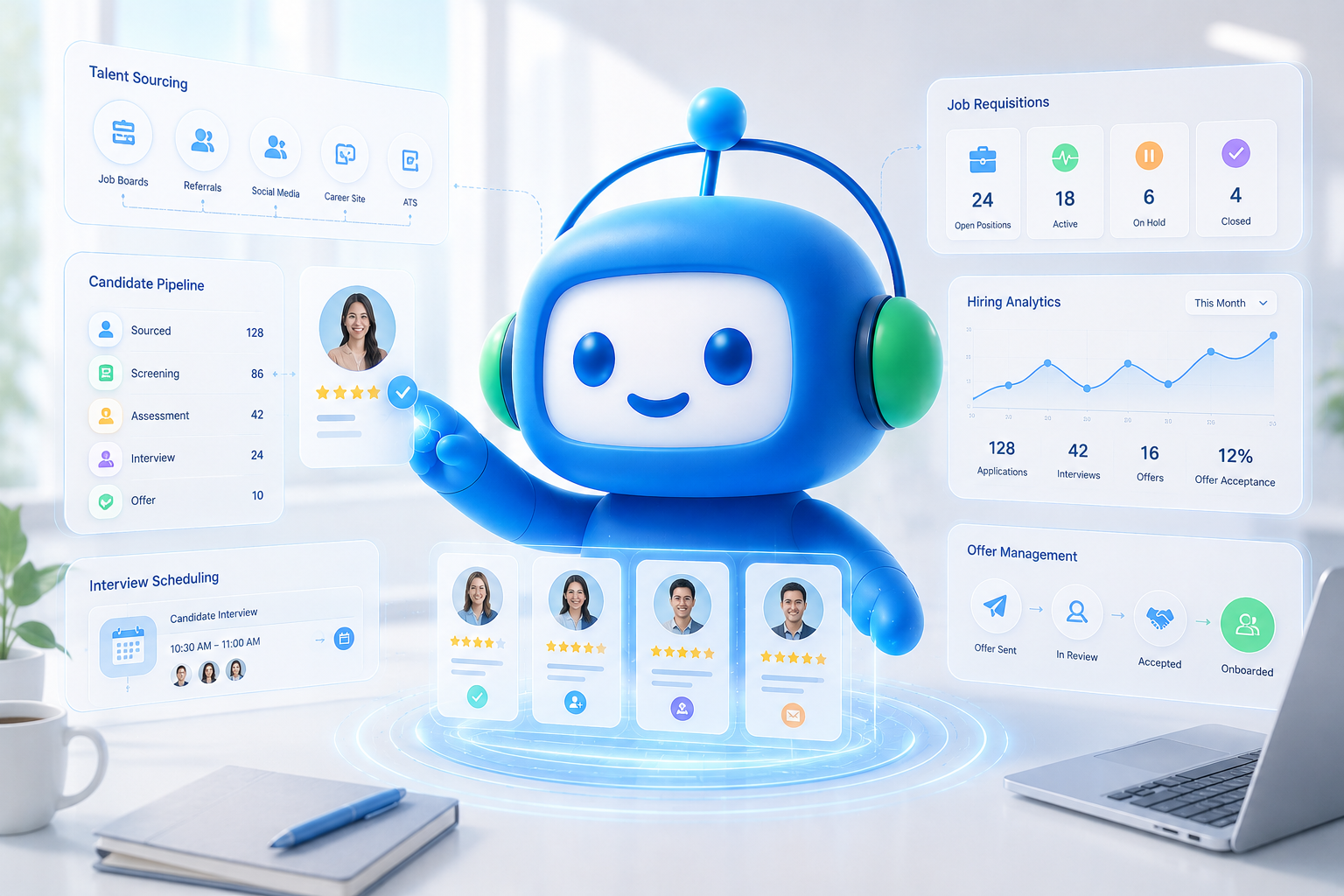
TalentRecruit’s enterprise recruitment platform addresses the specific complexity of GCC hiring directly not as a workaround but as a core design principle.
Multi-geography, multi-compliance hiring out of the box
TalentRecruit’s platform is built for global enterprise hiring deployed across India, Thailand, the UK, and other geographies by enterprise clients who need the same platform to behave differently in each location. Country and region-specific data privacy policies are configurable within the platform, so a GCC hiring simultaneously in Bengaluru and coordinating with stakeholders in London is automatically applying the right consent, retention, and data handling policies in each context without a compliance team manually managing the difference.
Passive talent identification for specialized GCC roles
Erika’s AI sourcing agent doesn’t rely on inbound applications. It continuously scans internal talent pools and external sources to identify candidates who match the specific, often highly technical requirements of GCC roles ML engineers, data scientists, cloud architects, product leaders including candidates who are currently employed and not actively looking. For GCC talent profiles that rarely apply through conventional channels, this is the sourcing approach that actually works.
Configurable workflows that match both global policy and local process
GCCs operate with structured hiring requirements from their parent organizations specific interview stages, assessment frameworks, approval chains, scorecard criteria. TalentRecruit’s highly configurable workflow engine allows GCC TA teams to build these requirements directly into the recruitment process, so they’re enforced consistently without requiring manual coordination at every stage. Approval workflows, interview panel structures, assessment triggers all configured once, applied consistently across every hire.
Real-time hiring intelligence across geographies
A global TA leader needs a different view of the hiring pipeline than a city-level recruiter. TalentRecruit’s analytics and reporting give enterprise GCC clients the ability to segment pipeline visibility by geography, business unit, role type, and hiring stage so each stakeholder sees what they need, in real time, without a weekly report manually compiled by someone in the middle.
Background verification integrated into the hiring workflow
GCCs hiring for roles with access to sensitive global systems, intellectual property, or financial data have non-negotiable background verification requirements. TalentRecruit’s integrated BGV ecosystem with access to multiple verification partners through a single platform ensures that BGV is not a post-offer afterthought but an embedded, automated stage in the hiring process, with full audit trail documentation and governance controls.
Scalable onboarding across locations and employment types
GCCs often hire across permanent, contractual, and consulting engagement types sometimes for the same function. TalentRecruit’s offer management and onboarding automation handles this complexity, generating the right documentation workflows for each engagement type and ensuring new hires are moving through pre-boarding without manual intervention from a recruiter who’s already managing the next wave of hiring.
The Talent Battle GCCs Are Actually Fighting
Here’s the dynamic that makes GCC hiring uniquely high-stakes in 2026: the competition for talent is not just between GCCs and local Indian enterprises. It’s between GCCs themselves.
When Microsoft, Google, Walmart, Adobe, and hundreds of other global firms are all competing for the same pool of senior AI and product talent in Bengaluru and Hyderabad, the organizations that hire faster — without compromising on quality or compliance — win. The ones with a slow, manual, recruiter-dependent process lose candidates to competitors who moved three days earlier.
Speed in GCC hiring is not a nice-to-have. It’s a competitive variable.
Autonomous hiring platforms compress the time between candidate identification and offer without removing the structured evaluation that GCCs require. They surface passive candidates that manual sourcing misses. They keep candidates engaged through the process with automated, intelligent communication that doesn’t depend on a recruiter remembering to follow up.
The result isn’t just faster hiring. It’s a competitive advantage in a talent market where the best candidates have options and make decisions quickly.
Building a GCC That Compounds
The GCCs that get hiring right in their early stages build something that compounds over time a talent brand, a structured pipeline, an institutional understanding of what good looks like for their specific context. The ones that get it wrong spend years trying to rebuild a reputation in a talent market that has long memories.
The infrastructure decisions made in the first two years of a GCC’s existence shape its talent trajectory for the decade that follows. An autonomous hiring platform that handles the operational complexity of multi-geography, multi-compliance, high-specification recruiting is not an overhead it’s the foundation that everything else is built on.
India’s GCC growth story is real and it’s accelerating. The hiring challenge at the center of it is equally real and it’s one that most recruitment platforms were simply not designed for.
The ones that are built for it are already making a difference for the GCCs that found them early.