



Recruiting for eCommerce at Scale: What Manual Hiring Is Costing You
- Ecommerce in India doesn’t move at a normal pace.
- Quick commerce platforms promise delivery in ten minutes. D2C brands scale from zero to national distribution in eighteen months. Marketplace giants run peak season hiring campaigns that need hundreds of roles filled before the next festival sale cycle begins. And behind every one of those business milestones is a hiring deadline that the TA team is racing to meet.
- The problem is that most eCommerce companies even the fast-growing ones are still running their recruitment manually. Spreadsheets tracking candidate stages. Recruiters copy-pasting job descriptions across twelve portals. Hiring managers chasing feedback on interview panels that happened three days ago. Offer letters going out a week after the decision was made, to a candidate who accepted something else by Tuesday.
- Manual hiring has a cost. In eCommerce, that cost compounds faster than in almost any other industry.
The eCommerce Hiring Problem Is Unique
- Ecommerce TA teams face a combination of pressures that makes their hiring challenge genuinely different from most enterprise recruiting.
- The role mix is unusually wide. A single eCommerce organisation might be simultaneously hiring for warehouse operations, last-mile delivery fleet, tech and product roles, digital marketing, customer experience, category management, and finance each with completely different candidate profiles, different sourcing channels, and different urgency levels. Managing all of this in a single, coherent process, without specialised recruitment infrastructure, is where most teams start to crack.
- The volume is unpredictable but unforgiving. eCommerce hiring doesn’t arrive in steady batches. It surges before a new city launch, before a funding-driven expansion, before peak season. When that surge arrives, the team that’s been managing manually suddenly needs to hire at three times the normal pace with the same headcount and the same process. Something always gives.
- The talent market moves fast and so do candidates. Strong eCommerce candidates especially in product, tech, and growth roles are not waiting around. They’re fielding multiple conversations simultaneously and making decisions quickly. A slow process, a delayed interview, an offer that takes ten days to generate any of these is enough to lose them to a competitor who moved faster.
- And attrition rates in eCommerce operations roles run high. Roles that were filled last quarter are open again this quarter. The hiring cycle never really stops it just runs continuously, at whatever pace the business is moving.
What Manual Hiring Actually Costs in This Environment
- When hiring teams talk about the cost of manual recruitment, the conversation usually stays at the surface time spent, positions unfilled, delayed onboarding. The real cost runs deeper.
- Speed-to-hire directly impacts revenue in eCommerce. An unfilled category manager role during peak season isn’t just an HR metric. It’s a gap in the team responsible for ensuring the right products are available, priced correctly, and promoted effectively. An unfilled operations lead in a new city launch means the launch either delays or launches under capacity. Manual hiring that adds two weeks to every offer process isn’t an administrative inefficiency it’s a direct drag on business outcomes.
- Inconsistent screening means inconsistent quality at scale. When recruiters are manually reviewing hundreds of applications across a dozen different role types, the screening quality varies with bandwidth and fatigue. The fifteenth application reviewed on a Friday afternoon isn’t getting the same attention as the third one reviewed on Monday morning. At scale, this inconsistency shows up in hire quality and hire quality in eCommerce, where operational roles have direct output implications, matters immediately.
- Candidate dropout is invisible but expensive. Every candidate who disengages because the process was too slow, the communication was too inconsistent, or the offer took too long to arrive represents a sunk cost the time spent sourcing, screening, and interviewing them, gone. In manual hiring, dropout is hard to track and harder to fix because the process itself is the cause.
- The recruiting team becomes the bottleneck, not the business. When sourcing, screening, scheduling, and offer management are all manual tasks, the TA team’s capacity directly caps the organisation’s hiring velocity. If the business needs to hire fifty roles next month and the team can manually process thirty, something either waits or gets compromised. In a fast-moving eCommerce environment, neither is acceptable.
What Changes When Hiring Is Autonomous
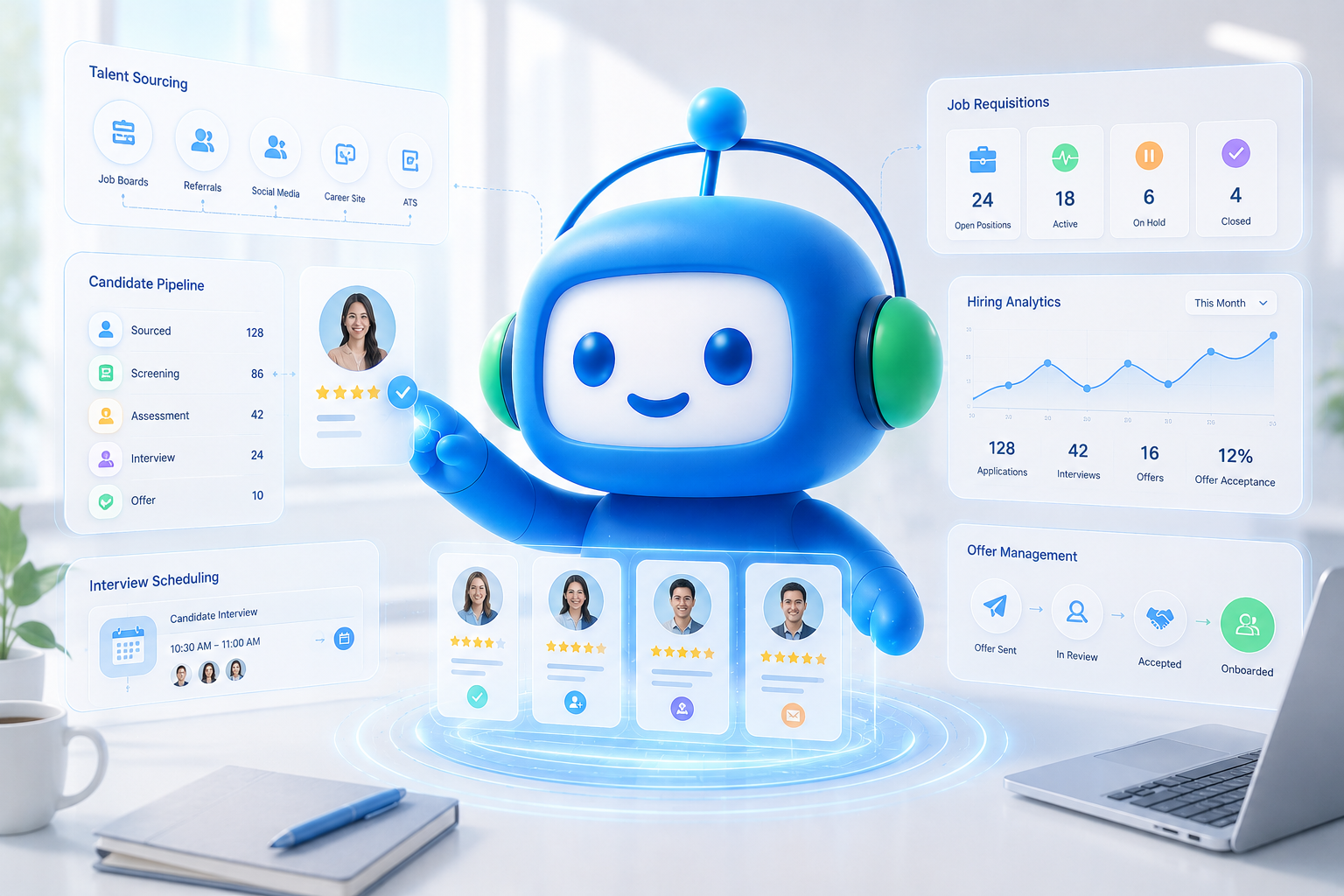
- TalentRecruit’s autonomous hiring platform was built specifically for the scale, speed, and complexity that eCommerce recruiting demands. Here’s what changes at each stage of the process.
- Sourcing that covers the full role spectrum simultaneously
- Erika’s AI sourcing agent doesn’t require a recruiter to run a separate search for every role type. It continuously identifies matched candidates across the organisation’s talent database and external sources for warehouse operations roles and product management roles and digital marketing roles simultaneously, against the specific requirements of each. The pipeline doesn’t wait for recruiter bandwidth to free up.
- Niche talent identification for specialised eCommerce roles
- For specialised roles digital marketing specialists, supply chain analysts, category managers, eCommerce platform architects passive talent identification is critical. The strongest candidates in these areas aren’t applying through job boards. AI-powered sourcing, combined with unified skill intelligence that understands eCommerce-specific competencies, surfaces these candidates where traditional keyword-based sourcing misses them entirely.
- AI-led screening that handles volume without variance
- Whether the team is screening twenty applications or two hundred, AI pre-qualification evaluates every candidate against the same criteria, at the same standard, and surfaces the most relevant profiles for recruiter review. The screening quality doesn’t degrade with volume. It doesn’t vary with the day of the week or the number of roles being managed simultaneously.
- Conversational AI interviews that scale candidate engagement
- For high-volume operational roles warehouse staff, delivery fleet, customer experience running individual recruiter-led screening calls at scale is simply not feasible. TalentRecruit’s conversational AI interviews conduct intelligent, real-time candidate interactions at scale, giving candidates a genuine engagement experience while generating structured assessment data that feeds directly into the hiring workflow. Candidate experience improves. Recruiter time is freed for the conversations that require it.
- Automated onboarding that closes the last mile
- In eCommerce, where onboarding speed has a direct impact on time-to-productivity and where new hires joining before a peak period need to be operational quickly the offer-to-onboarding process needs to be as fast as the hiring process itself. TalentRecruit’s onboarding automation ensures that once an offer is accepted, documentation, pre-boarding engagement, and onboarding workflows move without manual intervention. The candidate who accepted on Monday is ready to start on time.
- Built for the Pace of Quick Commerce
- TalentRecruit’s eCommerce and quick commerce solution is designed specifically for organisations where a hiring delay isn’t just an HR problem, it’s an operational one. From niche talent identification for specialised roles to AI-led conversational interviews for high-volume operational positions, the platform is built to match the pace that quick commerce and D2C businesses actually run at.
The Real Question for eCommerce TA Leaders
- Manual hiring in a slow-growth business is an inconvenience. Manual hiring in a fast-scaling eCommerce operation is a strategic liability.
- Every week of delay in filling a key role has a business cost that compounds. Every candidate lost to a slow process is a sunk cost the TA team rarely gets visibility into. Every inconsistent screening decision at scale quietly erodes the quality of the workforce being built.
- The eCommerce companies that are winning the talent game in 2026 are not the ones with the largest recruiting teams. They’re the ones with the right infrastructure one where AI handles the operational layer of hiring at whatever volume the business demands, and recruiters focus on the judgment calls and relationships that actually require them.
- The question isn’t whether autonomous hiring is relevant to eCommerce. It’s how much manual hiring is costing you while you wait to find out.