


The Recruiter’s Role in an Autonomous Hiring World: What Changes, What Doesn’t
- Every time a meaningful shift happens in how work gets done, the same question surfaces.
- Does this replace the people doing it?
- It happened with spreadsheets replacing paper-based tracking. It happened with ATS platforms replacing physical filing. And now, as autonomous hiring platforms begin to handle sourcing, screening, engagement, scheduling, and candidate assessment without manual intervention, the question is being asked about recruiters.
- The honest answer isn’t a reassuring deflection. It’s a more useful one: the recruiter’s role is changing significantly, and the parts that aren’t changing are the parts that matter most.
- Here’s a clear-eyed look at what autonomous hiring actually shifts and what it never will.
First, What Autonomous Hiring Is Actually Doing
- To understand what changes for recruiters, it helps to be specific about what autonomous hiring platforms are now capable of doing without them.
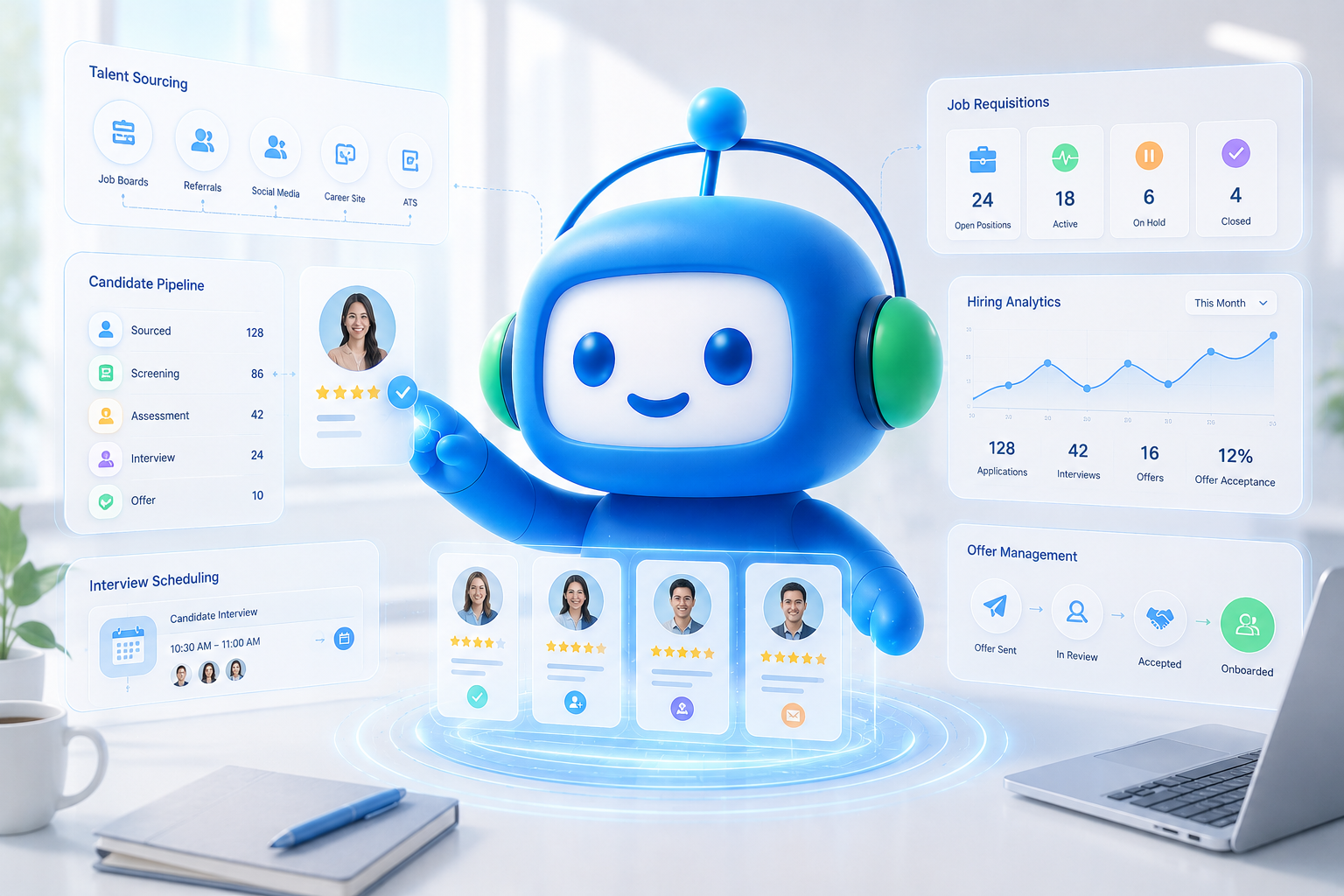
- Erika, TalentRecruit’s agentic AI recruiter, autonomously orchestrates sourcing across internal and external talent pools, engages candidates proactively across multiple channels, conducts conversational AI interviews at scale, generates AI-powered interview insights, schedules interviews without manual coordination, and moves candidates through hiring workflows without a recruiter manually pushing each stage forward.
- This isn’t a description of what’s coming. It’s what 25,000+ recruiters on TalentRecruit’s platform are already working alongside today, across 500+ enterprise implementations in 34 countries.
- The question isn’t whether this is happening. It’s what it means for the people in those teams.
What Changes: The Work That Was Never the Point
- Be specific about what autonomous hiring takes off a recruiter’s plate, and a pattern emerges. Almost all of it falls into a category that most recruiters, if they’re being honest never found to be the most meaningful part of the job.
- Manual sourcing and profile scanning. Hours spent searching databases, cross-referencing profiles, and trying to guess which keyword combination will surface the right candidate. Erika’s AI sourcing and matching agents handle this continuously and at a scale no individual recruiter can match.
- First-pass screening at volume. Reading through hundreds of applications to find fifteen worth a conversation. AI pre-qualification and conversational AI interviews do this consistently, without the fatigue that creeps into manual screening after the fiftieth application.
- Scheduling coordination. The back-and-forth between candidates and panel members to find a slot that works. AI interview scheduling handles this automatically, with calendar sync and candidate self-scheduling built in.
- Routine candidate follow-ups. The update emails, the stage notifications, the engagement touchpoints that keep candidates in the pipeline but don’t require a human to write individually. AI candidate engagement maintains this continuously, across channels, without recruiter bandwidth being the constraint.
- None of this is what drew most people into recruitment. It’s the administrative load that accumulated around the actual work and it’s what autonomous hiring removes.
What Doesn’t Change: The Work That Only a Recruiter Can Do
- Here’s what autonomous hiring cannot replicate and won’t.
- The judgment call on people.
AI can rank candidates by skill match, engagement signals, assessment performance, and interview insights. What it can’t do is sit across from someone or on a call with them and make the kind of human read that experienced recruiters develop over years. The instinct that tells you a technically strong candidate isn’t the right cultural fit. The conversation that reveals what a resume never could. The ability to genuinely assess potential, not just demonstrated history.
Autonomous hiring surfaces the shortlist. The recruiter makes the call.
- The relationship with the hiring manager.
Understanding what a hiring manager actually needs as opposed to what’s written in the job description is a relationship built through conversation, iteration, and trust. It changes across roles, across teams, and across business contexts. No AI agent replaces the recruiter who knows a hiring manager well enough to push back when the brief is wrong.
- Candidate experience at the moments that matter.
Autonomous hiring dramatically improves the transactional candidate experience faster responses, consistent communication, frictionless scheduling. What it doesn’t replace is the human interaction at the inflection points that shape how a candidate feels about a company. The conversation that addresses a concern. The call that keeps a strong candidate engaged when they’re weighing two offers. The recruiter who makes someone feel seen, not processed.
- Strategic talent advisory.
As autonomous hiring handles the operational layer of recruitment, the TA function’s value increasingly sits in what it advises workforce planning, talent market intelligence, hiring velocity insights, diversity and inclusion strategy. These are inherently human, inherently strategic, and inherently more valuable than the manual tasks being automated.
- TalentRecruit’s predictive talent intelligence and real-time dashboards give recruiters the data to have these conversations. The conversations themselves are still theirs to lead.
The India Context: Why This Matters More Here
- Indian enterprise recruiting has historically been resource-intensive. High-volume hiring, large applicant pools, manual coordination across geographies, and recruiting teams often stretched thin across more open roles than they can meaningfully manage simultaneously.
- Autonomous hiring doesn’t just make individual tasks faster in this context it restructures what’s possible for a TA team of a given size. A team that was managing fifty roles manually can manage significantly more with Erika handling the operational layer. The recruiter’s capacity expands not because they’re working harder, but because the system is doing the work that doesn’t require them.
- For TA leaders in Indian enterprises thinking about headcount, capability, and competitive hiring this is the real conversation. Not whether to adopt autonomous hiring, but how to position their teams for the role it creates rather than the role it replaces.
What the Best Recruiters Are Already Doing
- The recruiters thriving alongside autonomous hiring platforms aren’t the ones resisting the shift or simply waiting to be reassigned. They’re the ones who recognised early that the operational load was never where their value lived and who are now doing more of the work they’re actually good at.
- They’re spending more time with hiring managers, understanding business context, and shaping briefs that the AI can execute against effectively. They’re reviewing AI-generated insights and adding the human layer of judgment that turns a ranked shortlist into a confident hire. They’re building candidate relationships at the moments that matter, knowing the routine touchpoints are being handled.
- They’re, in short, being better recruiters because the parts of the job that were never about recruiting have been taken care of.
The Honest Answer to the Question
- Does autonomous hiring replace recruiters?
- No. But it does replace a version of the recruiter’s job that if most honest about it wasn’t the best use of what good recruiters are actually capable of.
- What replaces it is a role with more strategic weight, more human judgment, and more direct connection to the outcomes that hiring is actually supposed to deliver.
- The autonomous hiring world doesn’t have fewer recruiters. It has recruiters doing more of what only recruiters can do.
- That’s not a consolation. That’s the upgrade.