


From AI-Assisted to AI-Led: What the Shift Means for Your TA Team in 2026
There’s a version of AI in recruitment that most organisations have already lived with for a few years now.
It suggests candidates. It flags resumes. It sends automated emails when a recruiter sets it up to do so. It helps write a job description if you ask it nicely. It’s useful. It saves some time. But at the end of every task, a recruiter is still the one making things happen clicking the next step, chasing the next approval, moving the next candidate forward manually.
This is AI-assisted hiring. And for most enterprise TA teams, it’s been the ceiling of what AI in recruitment actually meant in practice.
That ceiling is gone in 2026. What’s replacing it is something fundamentally different not AI that assists a recruiter’s actions, but AI that leads the workflow autonomously, end to end, and hands the recruiter the decisions that genuinely require human judgment.
The distinction sounds subtle. The operational reality is anything but.
What AI-Assisted Actually Looked Like
To understand the shift, it helps to be specific about what AI-assisted recruitment was doing and where it stopped.
AI-assisted tools accelerated individual tasks. A sourcing tool surfaced candidate profiles faster than manual search. A screening tool ranked resumes so recruiters didn’t have to read all five hundred. A scheduling tool offered calendar slots without the back-and-forth.
But the workflow itself was still recruiter-driven. Every tool operated in its own silo. Sourcing didn’t talk to screening. Screening didn’t trigger scheduling. Scheduling didn’t connect to offer management. The recruiter was the connective tissue between every stage manually carrying information, status updates, and decisions from one tool to the next.
AI-assisted hiring made each individual step faster. It didn’t change the fundamental structure of how recruiting worked.
What AI-Led Hiring Actually Means
AI-led hiring what TalentRecruit calls autonomous hiring starts from a different premise entirely.
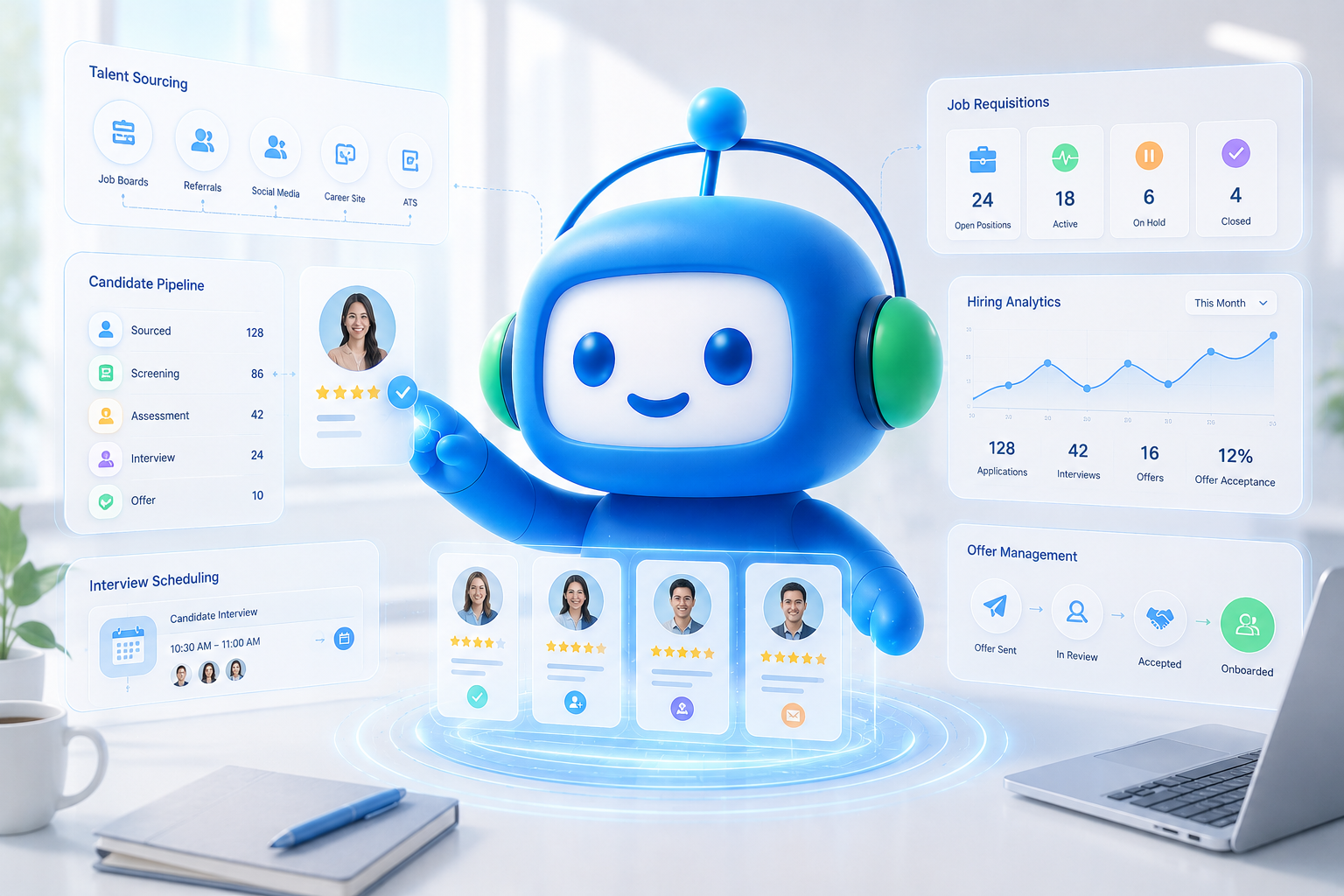
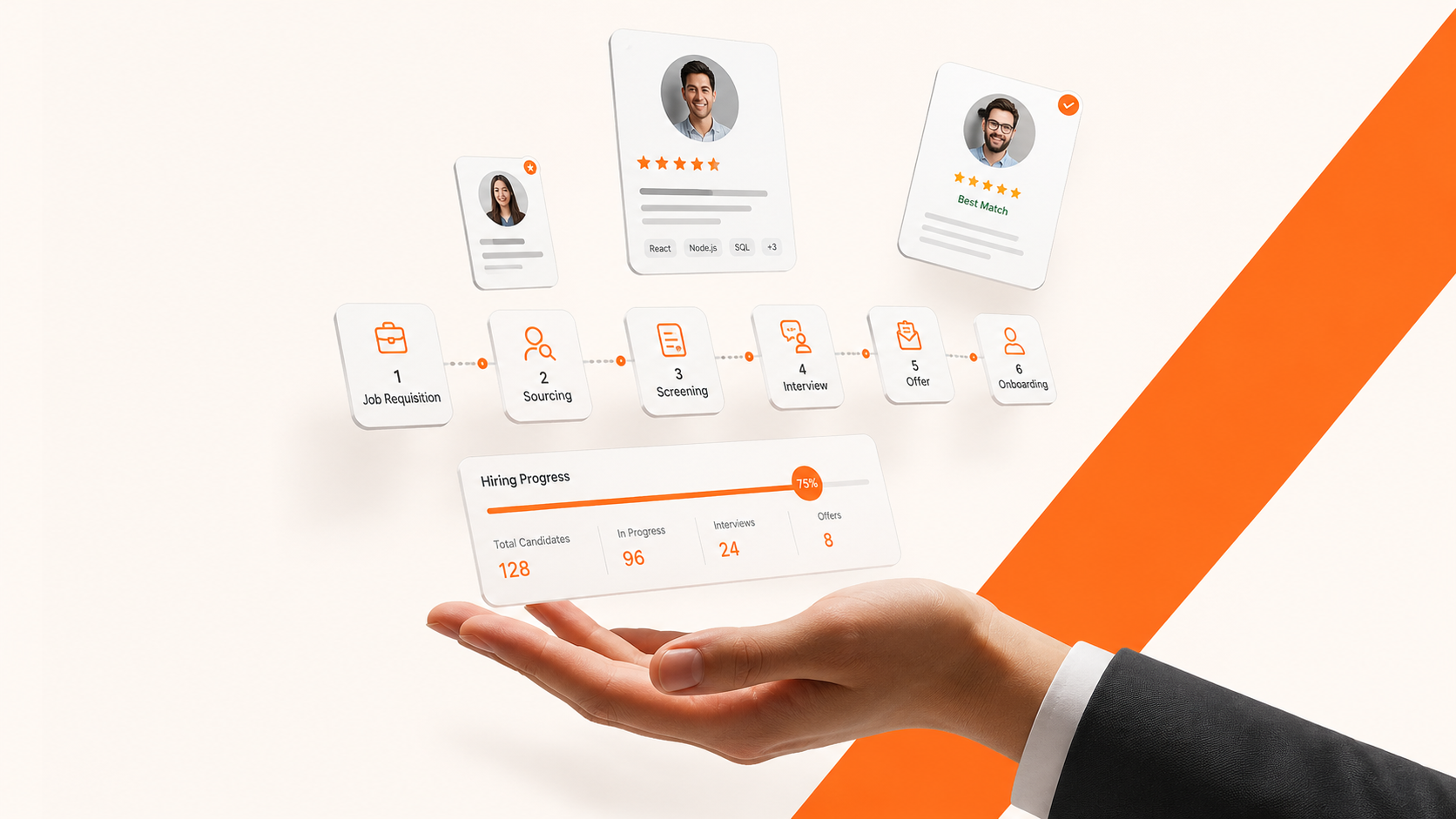
Instead of individual tools that accelerate isolated tasks, an AI-led platform deploys intelligent agents that orchestrate the entire hiring workflow. Sourcing, screening, candidate engagement, interview scheduling, assessments, and offer coordination don’t exist as separate steps that a recruiter manually connects. They exist as a continuous, automated process that runs from job requisition to hire with the AI agent executing each stage and the recruiter stepping in at the moments where human judgment changes the outcome.
This is what Erika, TalentRecruit’s agentic AI recruiter, is built to do. Erika doesn’t assist a recruiter’s individual actions. It autonomously orchestrates sourcing across internal and external talent pools, engages candidates proactively across multiple channels, conducts intelligent conversational AI interviews at scale, and moves candidates through the pipeline without manual intervention at every stage.
The recruiter doesn’t disappear from this picture. They move to a different position in it.
What Changes for Your TA Team
The shift from AI-assisted to AI-led changes what a recruiter’s working day actually looks like — and what the TA function is responsible for delivering.
The recruiter’s role shifts from execution to oversight
In an AI-assisted model, recruiters spend the majority of their time doing things — searching, screening, scheduling, following up, updating systems. In an AI-led model, the doing is handled by agents. Recruiters spend their time reviewing what the AI has surfaced, making calls on candidates that warrant closer consideration, and managing the relationships and conversations that only a human can navigate well.
This isn’t a reduction in the recruiter’s value. It’s a concentration of their value on the work that actually requires them.
Decision-making becomes data-backed, not instinct-driven
AI-led platforms don’t just move faster — they generate richer signal at every stage. TalentRecruit’s Deep Skill Intelligence brings together data from resumes, conversational interviews, assessments, and candidate engagement touchpoints into unified, explainable candidate insights. Recruiters and hiring managers aren’t making decisions based on a resume and a gut feeling. They’re working from a structured picture of what each candidate actually demonstrates and why the AI ranked them where it did.
High-volume hiring stops requiring proportional headcount
One of the practical limits of AI-assisted hiring was that scale still required people. More open roles meant more recruiters doing more manual work, even if each individual task was somewhat faster. AI-led hiring breaks that equation. When agents handle sourcing, screening, and scheduling autonomously, a TA team of the same size can manage significantly higher hiring volume without the process breaking down.
This is directly relevant for enterprise organisations running high-volume hiring across multiple geographies and business units where the alternative has historically been either a larger recruiting team or a compromised process.
Candidate experience improves as a byproduct of speed
One of the less-discussed costs of manual, recruiter-driven hiring is candidate experience. When a recruiter is managing fifty open roles, response times slow down, follow-ups get missed, and candidates particularly the strongest ones who have options disengage before the process reaches them.
An AI-led platform engages candidates proactively and continuously, across channels, without recruiter bandwidth being the constraint. Erika’s conversational AI bot interviews give candidates real-time, intelligent interaction at the screening stage not a static form to fill and wait on. The experience improves not because someone decided to prioritise it, but because the architecture of the platform makes it a natural outcome.
The Transition Is Already Underway
For TA leaders evaluating where their function needs to go in 2026, the question is no longer whether AI-led hiring is real or relevant. Organisations across industries BFSI, logistics, manufacturing, eCommerce are already running autonomous hiring workflows at enterprise scale. The gap between teams that have made the shift and those still running AI-assisted processes is widening in measurable ways: time-to-hire, quality of shortlists, recruiter capacity, and candidate conversion rates.
The transition from AI-assisted to AI-led isn’t a technology upgrade. It’s a rethinking of what the TA function is responsible for and where human judgment in hiring actually belongs.
The teams making that shift in 2026 aren’t just hiring faster. They’re building a recruitment function that compounds one that gets better, faster, and more predictable as the AI agents accumulate more signal and the recruiters get better at the decisions only they can make.
That’s the real meaning of the shift. And for enterprise TA teams, it’s already the present not something still on the horizon.